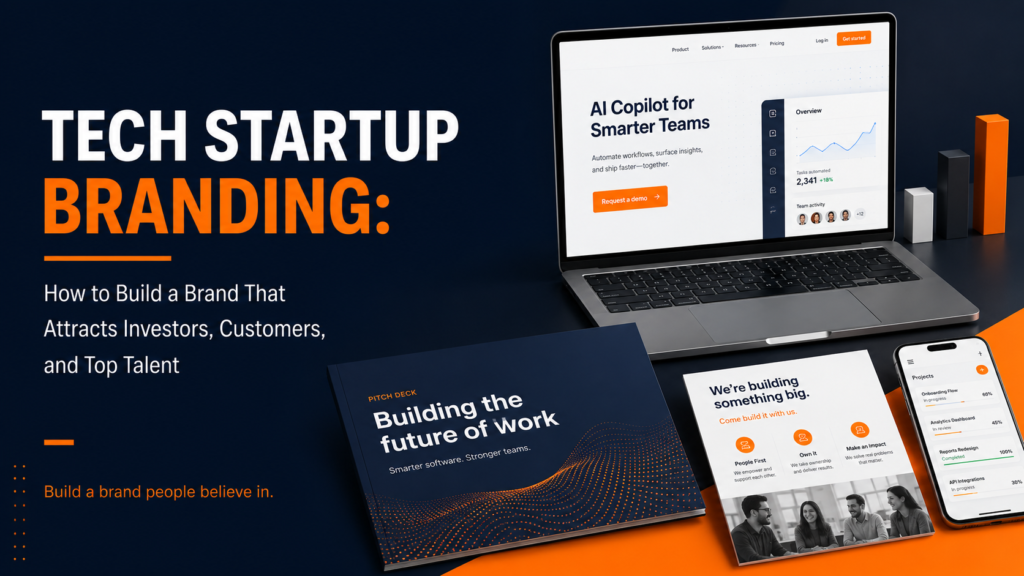
Tech Startup Branding: How to Build a Brand That Attracts Investors, Customers, and Top Talent
Tech startups face a unique branding challenge. They operate in a category where the visual conventions are well-established (blue, sans-serif, clean interfaces), the competition is intense, and the audiences they need to reach—investors, enterprise buyers, technical talent, and consumer users—all read brand signals differently. A visual identity that appeals to enterprise procurement managers can alienate the technical talent you need to build your product. A playful consumer brand can tank your chances in a Series A pitch.
Successful tech startup branding doesn’t try to solve all of these audiences simultaneously with a single aesthetic. Instead, it builds a visual and verbal identity system that establishes a core brand character strong enough to adapt across contexts while remaining consistently recognizable. This guide explains how that system works and how to build it.
“The best tech brands are not the ones that look like technology. They’re the ones that look like the human outcome technology enables.” — Sagmeister & Walsh
The Specific Challenges of Tech Startup Branding
The Credibility Paradox
Early-stage tech startups need to signal credibility they haven’t yet earned. You have limited customer references, limited track record, and limited time to establish trust with every new audience you encounter. Your brand is often doing more credibility-building work than any other element of your pitch. A polished, coherent brand says “this team has its act together” before a word is spoken. A rough, inconsistent brand raises doubt about execution capability.
The Multiple Audience Problem
Investors, enterprise buyers, technical talent, and end users all read brand signals differently:
- Investors look for ambition, category clarity, and team competence
- Enterprise buyers look for reliability, security, and proof of scale
- Technical talent looks for craft quality, mission clarity, and cultural fit
- End users look for simplicity, trust, and clear benefit
These requirements aren’t always in conflict, but they require different emphasis in different contexts. Your core brand needs to be strong enough that it adapts to each audience’s primary signal without feeling inconsistent.
The Speed Trap
Startups move fast. The temptation is to defer brand investment until “things are more stable” or “we know exactly who our customer is.” The problem is that you’re actively making brand decisions every day whether you’ve formalized them or not: every pitch deck slide, every social post, every email signature is building a brand impression. The question isn’t whether to invest in brand—it’s whether to do it intentionally or accidentally.
Tech Startup Brand Architecture: What You Need and When
The mistake most founders make is waiting until Series A to invest in brand, by which point they’ve already made 18 months of inconsistent brand impressions with investors, customers, and candidates. The minimum viable brand investment at the seed stage—logo, colors, typography, and basic usage guide—costs far less than people assume and pays compounding returns.
For a complete look at what a startup-stage brand identity system includes, see the brand identity design services guide and the startup-focused design services.
Tech Startup Brand Naming: Principles That Work
Your company name is your most public brand decision. In tech, there are well-established patterns for names that build recognition:
Real Words with New Context
Stripe, Square, Slack, Box. Ordinary words that carry relevant metaphorical weight and are easy to say, spell, and search. The limitation: as tech naming has converged on this approach, the universe of viable short real-word names has shrunk considerably. Many of the best options are trademarked.
Invented Words
Spotify, Twilio, Zendesk. Coined words that can be trademarked and are search-unique. The benefit is distinctiveness; the cost is more effort required to establish meaning through brand investment.
Descriptive + Qualifier
HubSpot, Salesforce, Dropbox. Direct description of the value proposition, often more approachable for enterprise buyers who need to explain software purchases to non-technical stakeholders. The limitation: can feel generic over time, and product evolution often outpaces the literal meaning of the name.
Acronyms and Lettermarks
IBM, SAP, VMware (started as vmware). Work best when the full name is unwieldy. Require significant brand investment to build meaning into an otherwise abstract sequence of letters. Generally not recommended for early-stage startups.
Visual Identity for Tech Startups: Breaking the Blue Box
The dominant visual pattern in tech startup branding is what designers call “the blue box”: blue primary color, geometric sans-serif typeface, clean minimalist layout, and stock photography of either interfaces or diverse teams in glass-walled offices. The pattern exists because it works: blue signals trust, geometric sans-serifs signal modernity, and clean layouts signal technical competence.
The problem is that when every brand in your category uses the same pattern, none of them are remembered. Recognition requires differentiation, and differentiation requires departure from the default.
Differentiation Strategies That Work in Tech
Unexpected color: A warm terracotta, a deep forest green, or an elegant burgundy can create instant differentiation in a sea of blue-and-white tech brands. The color needs a story—why this color for this company—but the visual impact is immediate.
Distinctive typography: Most tech brands use one of a handful of geometric sans-serifs (Inter, Neue Haas Grotesk, Aktiv Grotesk). A carefully chosen typeface with genuine personality—a refined humanist sans, a confident contemporary serif, a custom display face—can establish visual distinctiveness without any other changes.
Illustration system: Custom illustration distinguishes tech brands memorably because it requires genuine creative investment that competitors can’t quickly replicate. When the illustration style is distinctive and consistently applied, it becomes a recognizable brand asset. Mailchimp’s Freddie, Dropbox’s illustrated scenarios, Stripe’s gradient art direction—all created strong brand recognition through visual distinctiveness.
Strong editorial art direction: Your photography and imagery choices are where most tech brands leave the most differentiation on the table. Moving from generic stock photography to a distinctive editorial direction—specific types of subjects, specific color grades, specific compositional approaches—can transform a brand’s visual presence without changing any structural identity element.
Brand Voice for Tech Startups
Technical products need non-technical voices. The most valuable brand voice distinction available to tech startups is writing about the human outcome of the technology, not the technology itself. Your competitors all talk about their features, their architecture, their integrations. The brand that consistently talks about the transformation it creates for customers occupies a different mental position—and is remembered more readily.
The Four Voice Attributes Every Tech Brand Needs to Define
The Pitch Deck and Brand Consistency
For early-stage tech startups, the pitch deck is often the most-seen brand expression. Before you have an audience, you have investors. Before you have enterprise customers, you have pilots. Before you have press coverage, you have conference presentations.
A pitch deck that looks significantly different from your website, product, and marketing materials creates a jarring brand inconsistency at exactly the moment when coherence matters most. The brand system built for marketing should be the same system applied to investor materials. If your pitch deck requires different colors, fonts, or visual treatments to work well, your brand system has a gap.
See how brand-consistent pitch decks are built at the pitch deck and business brochure design service, and read the complete guide to pitch deck design.
Tech Startup Employer Brand
Employer brand is increasingly indistinguishable from company brand in the tech sector. Candidates research companies as thoroughly as customers do, and they read brand signals with the same critical eye. A strong employer brand—clearly articulated culture, visible values, authentic team representation, and compelling mission—reduces recruiting time and improves the quality of candidates who apply.
The tech talent market is particularly sensitive to employer brand quality. Exceptional engineers have choices. They choose companies whose brand signals mission clarity, operational competence, and cultural fit—and reject companies whose brand signals chaos, mediocrity, or misalignment with their values.
Maintaining Brand Consistency Across a Growing Team
Brand consistency in a three-person startup is a conversation. Brand consistency in a 30-person startup requires documentation and enforcement. The transition point is usually around 10–15 people, when the informal “we all know what the brand is” becomes untenable because new team members are creating content without context.
Infrastructure for maintaining tech startup brand consistency:
- Brand guidelines document — Accessible, searchable, with visual examples of correct and incorrect use
- Asset library — All logos, icons, fonts, and templates in one shared location (Google Drive, Figma, Notion)
- Figma component library — For product and marketing teams, a shared design system that enforces visual consistency
- Brand owner — One person responsible for brand decisions, update management, and exception handling
- Vendor briefing template — A one-page document sent to every external contractor, agency, and freelancer on day one
For SaaS-specific brand system considerations, the SaaS brand identity design service covers the design system and component library components that tech brands specifically need. For branding agency context, see how to choose a branding agency for your startup.
Build a Tech Brand That Investors and Customers Both Trust
Tech startup branding is not just about looking good. It’s about creating the credibility, differentiation, and consistency that compound into a real competitive advantage. Whether you’re building from scratch or refreshing a brand that’s grown inconsistently, the right design process makes the difference.