Brand Audit: How to Diagnose Your Brand’s Strengths, Gaps, and Opportunities for Growth
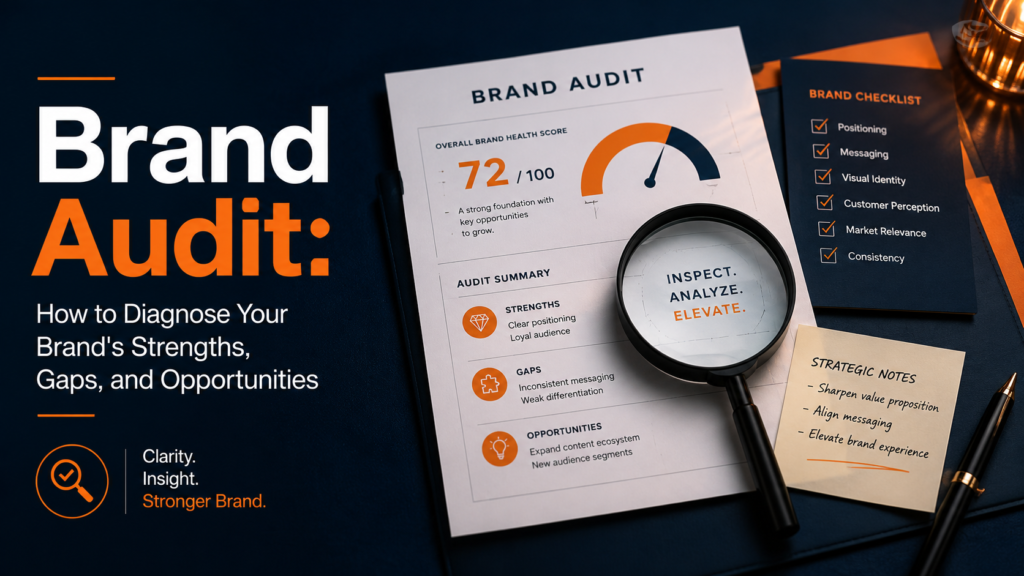
A brand audit is a systematic assessment of every element of your brand — how it presents itself, how it’s perceived, and how it performs against its strategic objectives. It’s the business equivalent of a full health check: not a response to a specific problem, but a comprehensive review that reveals both what’s working and what’s silently costing you customers, revenue, and competitive position.
Most brands evolve without strategic oversight. A logo gets tweaked here. A color gets added to a campaign there. A new team member starts using a slightly different tone in social posts. A new vendor designs a print brochure without following the guidelines. Over months and years, these small divergences accumulate into brand fragmentation — the point where your brand no longer looks, sounds, or feels like a unified system. A brand audit is how you find that fragmentation and fix it before it becomes structural.
This guide explains what a brand audit is, how to conduct one, what you’re looking for, and how to turn audit findings into a clear action plan.
“You can’t manage what you don’t measure. A brand audit is the measurement that makes brand management possible.” — Brand management principle
Why Brand Audits Matter
Companies conduct financial audits because financial health has quantifiable impacts on business outcomes. Brand health has equally direct impacts — on customer acquisition costs, on pricing power, on employee recruitment and retention, on investor confidence — but those impacts are harder to see and therefore easier to ignore.
The cost of brand fragmentation is real but diffuse: slightly lower conversion rates on every marketing channel, slightly reduced credibility in every sales conversation, slightly higher recruiting costs for every open role. No single instance is catastrophic; the cumulative effect is significant. A brand audit makes this invisible cost visible.
Specific situations that always warrant a brand audit:
- Before a significant rebrand or brand refresh investment (to understand what to change and what to keep)
- After significant company growth (when new team members and vendors have been applying the brand independently)
- Before a fundraising round (to ensure the brand presentation matches the company’s current stage and ambitions)
- Before a market expansion (to assess whether the current brand works in the new market)
- When conversion rates have declined without obvious explanation (brand confusion is often a contributing factor)
- When recruiting has become more difficult (employer brand often diverges from customer brand over time)
The Four Dimensions of a Brand Audit
Dimension 1: Visual Identity Audit
A comprehensive review of how the visual identity is applied across every brand touchpoint. This isn’t just evaluating whether things look good — it’s assessing consistency, compliance with brand standards, and performance in context.
What to audit visually:
- Logo usage: Are all variants correct? Are prohibited uses occurring? Are proportions correct in all applications?
- Color application: Is the correct color palette being used? Are there off-brand colors appearing in any materials?
- Typography: Are the correct typefaces being used everywhere? Are the size and weight hierarchy consistent?
- Photography: Does the imagery direction feel consistent? Is stock photography misaligned with brand direction?
- Layout and spacing: Is there a consistent approach to composition and whitespace across materials?
- Touchpoint inventory: Collect one example of every touchpoint (website, social profiles, email signature, business card, presentation template, proposals, invoices, packaging, etc.) and evaluate them side by side
Dimension 2: Verbal Identity Audit
How consistent is the brand’s written voice across all communications? A verbal audit evaluates:
- Consistency of brand voice across website copy, social media, email, and marketing materials
- Clarity and specificity of value proposition statements
- How consistently brand messaging pillars appear across content
- Whether the company’s current offering and positioning is accurately reflected in all copy
- Jargon, terminology, and naming consistency across all materials
Dimension 3: Competitive and Market Audit
How does the brand position and present itself relative to the competitive landscape? This dimension prevents “internal echo chamber” — the tendency to evaluate the brand only against itself rather than against the market.
Dimension 4: Brand Performance Audit
What business outcomes is the brand delivering? This connects brand health to business metrics:
- Awareness: Do target customers know the brand exists? What prompted awareness?
- Consideration: When target customers have a relevant need, do they include this brand in their consideration set?
- Preference: Among brands in the consideration set, is this brand preferred? Why?
- Loyalty: Do current customers repurchase? Do they refer? What’s the NPS?
- Digital brand signals: Branded search volume trend, direct traffic trend, social media follower growth and engagement
The Brand Audit Process
Phase 1: Asset Collection
The first step is gathering every brand asset and brand touchpoint example in one place. This is often more difficult than it sounds. Many organizations don’t have centralized asset management, and examples of the brand in use are scattered across teams, vendors, and channels. A thorough asset collection should include:
- All logo files (wherever they are stored)
- Brand guidelines documentation (if it exists)
- Website screenshots across all pages
- Social media profiles and recent post samples
- Email templates and recent campaign examples
- Presentation templates and recent decks
- Print materials (business cards, brochures, sales collateral)
- Product packaging and labels
- Any advertising materials
- Vendor-produced materials (anything a printer, developer, or agency has produced using the brand)
Phase 2: Side-by-Side Analysis
Lay everything side by side — literally, on a large screen or a printed grid — and evaluate it as a unified system. Questions to answer: Does this all look like it came from the same company? Where are the most significant inconsistencies? What’s performing well visually and what isn’t? Is the brand presenting itself at a level appropriate for its current stage and market position?
Phase 3: External Research
Internal analysis reveals what the brand is doing. External research reveals how it’s actually being perceived. This can range from lightweight (reading all Glassdoor reviews, surveying recent customers with a brand perception questionnaire) to comprehensive (market research with target segments, customer interviews, competitive perception research). Even lightweight external research typically surfaces significant insights that internal analysis misses.
Phase 4: Gap Analysis and Prioritization
The audit produces a list of findings. The gap analysis translates those findings into a prioritized list of issues ranked by business impact. Not every finding is equal: a misapplied logo on a rarely-used internal template is a lower priority than inconsistent color usage on the homepage hero. Prioritization ensures that action follows from strategic importance, not just ease of fixing.
Phase 5: Action Plan
The output of the audit is not a report — it’s an action plan. Each prioritized finding should become a specific action: who owns it, what they need to do, by when, and what success looks like. Without an action plan, audits produce insight that sits in a document rather than change that improves the brand.
DIY Audit vs. Professional Brand Audit
A self-conducted brand audit has a fundamental limitation: the people closest to the brand are the least able to see it clearly. Internal teams are subject to familiarity bias (visual inconsistencies become invisible when you’ve seen them every day for two years) and organizational blind spots (sacred cows that nobody dares criticize).
A professional brand audit brings external perspective that internal teams can’t provide. It also brings a structured methodology that surfaces issues systematically rather than relying on what happens to be noticed. For organizations with significant brand equity at stake — preparing for a funding round, launching in a new market, or navigating a brand refresh — professional audit is worth the investment.
For brands building their identity from scratch or refreshing an existing one, the brand audit is often the first step. For the full brand identity design and strategy service that often follows a brand audit, see the branding and identity design service. For a closer look at what brand refresh work involves, see the brand refresh guide.
Ready to See Your Brand Clearly?
A brand audit gives you a complete, honest picture of where your brand is strong, where it’s fragmented, and what it would take to bring it to where you need it to be. Start with clarity — then act on it with confidence.