Brand Positioning: The Strategic Foundation That Makes Every Marketing Dollar Work Harder
Every brand exists somewhere in the minds of its customers. It occupies a position — a set of associations, a place in a mental category, a comparative relationship to alternatives. Brand positioning is the discipline of choosing that place intentionally rather than letting it form by accident. It’s the most fundamental strategic decision a company makes, because everything else — the visual identity, the messaging, the product roadmap, the pricing — follows from it.
Most companies have never made an explicit positioning decision. They’ve described their products, built websites, run campaigns, and let the market assign them a position based on whatever impressions accumulated. The problem with this approach is that the position the market assigns is usually generic: “another option in this category,” “similar to the market leader,” or worst of all, invisible.
This guide explains what brand positioning actually is, how to diagnose your current position, and how to build a positioning strategy that creates durable competitive advantage.
“Positioning is not what you do to a product. It’s what you do to the mind of the prospect.” — Al Ries and Jack Trout, Positioning: The Battle for Your Mind
What Brand Positioning Is (and What It Isn’t)
Positioning is often confused with messaging, taglines, or advertising. These are expressions of positioning, not positioning itself. Positioning is the underlying strategic claim about where your brand sits relative to the competitive alternatives in your category.
A useful positioning consists of three components:
- Category definition: What game are you playing? What competitive set does the customer consider when they might buy from you?
- Differentiation: Within that category, what do you do differently or better than the alternatives?
- Target customer: For whom is this differentiation most valuable?
Positioning is not:
- A tagline (“Just Do It” is the expression of Nike’s positioning, not the positioning itself)
- A mission statement (“We exist to empower every person to achieve more” describes purpose, not position)
- A list of features (features are evidence for positioning claims, not the claims themselves)
- A brand personality (personality is how you express the position, not the position)
Why Positioning Matters More Than Any Other Brand Decision
Every other brand investment — visual identity, content, advertising, events, partnerships — builds on top of the positioning. A brand with clear positioning gets compounding returns on those investments: each new piece of content reinforces the same mental association, making it stronger with every impression. A brand without clear positioning gets no compounding: each piece of content builds something slightly different, and nothing accumulates into a durable advantage.
Positioning also determines pricing power. Brands that occupy distinct, valued positions in customers’ minds command premium prices. Brands that are perceived as interchangeable alternatives compete primarily on price. The difference between these two outcomes is almost entirely a function of positioning clarity.
The Four Types of Brand Positioning Strategies
1. Category Leadership
Positioning as the definitive, leading choice in an established category. The mental shorthand: “the name everyone knows in the category” Salesforce for CRM. HubSpot for inbound marketing. Mailchimp for email marketing. Category leaders benefit from the lowest customer acquisition costs (customers actively looking for the category find them first) and the highest pricing power.
The challenge: category leadership is only achievable in categories where you are genuinely ahead. Claiming leadership you haven’t earned damages credibility. And once achieved, it requires continuous investment in thought leadership, product excellence, and community to defend.
2. Attribute Ownership
Owning a specific attribute within a broader category. Not “the best CRM” but “the easiest-to-use CRM.” Not “the best accounting software” but “the accounting software built for service businesses.” Attribute ownership allows smaller brands to win a specific dimension against larger, more well-known competitors. It’s the positioning strategy available to challengers.
The most valuable attributes to own are ones that are genuinely important to a substantial segment of the market and genuinely underserved by existing options. “Easiest to use” is valuable in categories where complexity is the primary barrier to adoption. “Most affordable” is valuable in categories where price is the primary barrier. “Most secure” is valuable in categories where risk is the primary concern.
3. Audience Specialization
Serving a specific audience distinctly better than any generic alternative. “The project management tool for law firms.” “The accounting platform for e-commerce brands.” “The CRM for real estate investors.” Audience specialization is particularly powerful in professional services and B2B software because specialized solutions genuinely do serve specific workflows better than generic ones — and specialized positioning communicates this fit immediately.
4. Values and Mission Alignment
Positioning on what you believe rather than what you do or who you serve. Patagonia’s environmental activism. Ben & Jerry’s social justice positioning. These positions attract customers who share the values and create fierce loyalty among them. Values-based positioning is most durable when the values genuinely permeate the business — not just marketing — and most fragile when they’re exposed as performance.
How to Define Your Brand Position: A Step-by-Step Framework
Step 1: Map Your Competitive Landscape
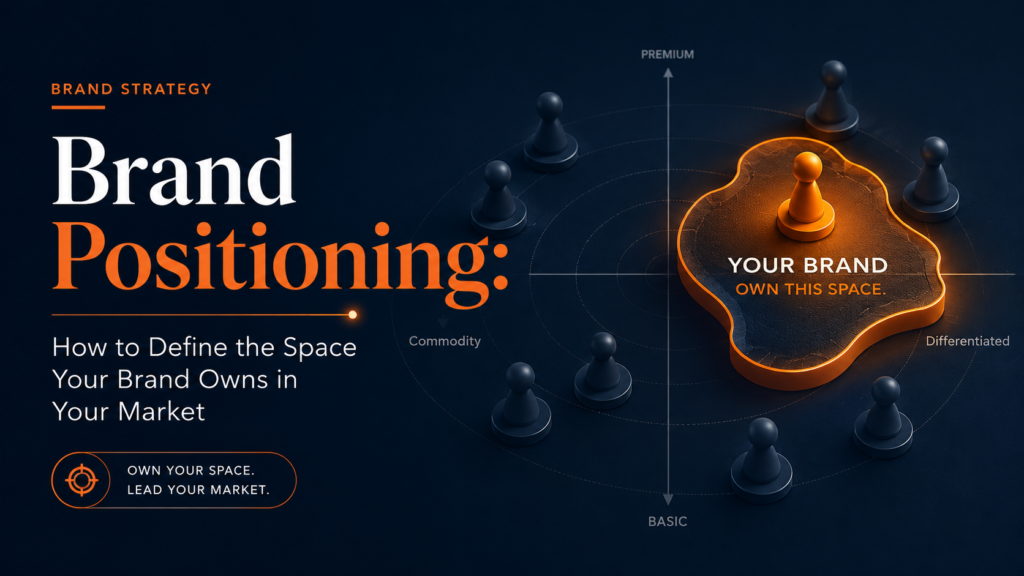
Before you can choose a position, you need to understand the landscape you’re positioning within. Identify your top 8–10 direct competitors. For each, document: their primary positioning claim, their target customer, their key differentiators, their pricing tier, and their visual and verbal brand personality. Map them on a two-axis matrix using the dimensions most relevant to your category — price vs. quality, simplicity vs. power, specialist vs. generalist.
The white space on this map — the positions no current competitor owns — is where your positioning opportunity lives. This analysis often reveals that most competitors in a category cluster around the same positioning (usually some variation of “the best/most complete/most powerful”), leaving specific audience segments, specific attributes, or specific use cases completely unserved at the positioning level.
Step 2: Interview Your Best Customers
Your best customers — the ones who pay the most, stay the longest, and refer the most — hold the key to your natural positioning. Interview them. Ask: Why did they choose you over alternatives? What do they tell colleagues about you when recommending? What would they lose if you disappeared? What words do they use to describe you?
The language your best customers use about you is often better positioning copy than anything a strategist would generate from scratch. It reflects how the value you create is actually perceived and communicated, not how you wish it were perceived.
Step 3: Define the Target Customer with Precision
Positioning requires a specific audience. “Everyone who needs X” is not a target customer — it’s a refusal to make a choice. The tighter the target customer definition, the more specific and resonant the positioning can be.
A useful target customer definition includes:
- Role or demographic (who they are professionally or personally)
- Context (what situation they’re in when they need what you offer)
- Jobs to be done (what they’re trying to accomplish)
- Current alternatives (what they use now or what they’re comparing you to)
- Pain with current alternatives (what’s frustrating or insufficient about the status quo)
Step 4: Identify Your Defensible Differentiation
Differentiation is only strategically valuable if it’s real, relevant, and defensible. It’s real if it’s actually true — if a customer evaluated both you and your competitor, they would verify the claim. It’s relevant if the differentiation is something the target customer actually cares about. It’s defensible if it’s difficult for competitors to replicate quickly.
The most defensible differentiators are usually structural: proprietary data, deep customer relationships, brand reputation built over years, or network effects that increase value as the user base grows. Feature-based differentiation is the least defensible because features are copyable.
Step 5: Write the Positioning Statement
The positioning statement is an internal strategic document, not a tagline or advertising claim. It should be specific enough to guide every product, marketing, and communication decision, and clear enough that everyone in the organization can explain what it means.
The classic format: For (target customer) who (has this problem), (Brand) is the (category) that (delivers this specific benefit) because (reason to believe).
Good positioning statement: “For Series A SaaS founders who need to close enterprise deals without a dedicated sales team, Acme is the sales enablement platform that shortens the first enterprise deal cycle from 6 months to 8 weeks because it’s purpose-built for founder-led sales with automated follow-up and built-in legal review workflows.”
Weak positioning statement: “For businesses who want to grow faster, Acme is the best sales platform that helps you close more deals because it has great features.”
Repositioning: When and How to Change Your Position
Repositioning is one of the hardest things a brand can do because it requires changing established mental associations — associations your customers have spent time and money forming. It’s worth doing when the current position is actively harming the business: when it attracts the wrong customers, prevents access to a more valuable market, or no longer reflects a genuine competitive advantage.
Repositioning strategies that work tend to share three characteristics: they build on some element of the existing position rather than abandoning it entirely, they are backed by genuine product or service changes (not just marketing), and they are communicated with patient consistency over a long enough period to actually shift perception.
For how positioning connects to the full brand strategy system, see the branding strategy guide for startups. For how visual identity should express and reinforce positioning, see the brand identity design services guide.
Positioning for Startups: Specific Considerations
Startup positioning faces a specific challenge: you often have limited evidence to support strong positioning claims at early stages. You can’t say “the market leader” if you’re pre-revenue. You can’t say “trusted by thousands” if you have twelve customers. The temptation is to position vaguely — to make broad claims that require less evidence to support.
Resist this. Vague positioning is worse than no positioning because it requires customers to do the work of figuring out why they should choose you, and most customers won’t do that work.
Early-stage startup positioning strategies that work:
- Category creation: If your product genuinely doesn’t fit an existing category, name a new one and position yourself as its pioneer. This requires more education work but captures the highest long-term value.
- Narrowly defined audience leadership: You may not be able to claim leadership of a broad category, but you can legitimately be the best option for a very specific audience. Start narrow, establish genuine leadership there, then expand.
- Principle-based differentiation: What you believe about how things should be done can be a legitimate differentiator when it’s genuine and when it maps to something customers actually want.
For startups building brand identity alongside their positioning strategy, the startup design services approach builds visual identity from the positioning up — not the other way around.
Build Positioning That Creates Competitive Advantage
Brand positioning is the most leveraged brand investment you can make. Get it right, and every marketing dollar works harder. Every content piece reinforces the same mental association. Every sales conversation starts from a stronger foundation. Let’s build yours with the strategic rigor it deserves.