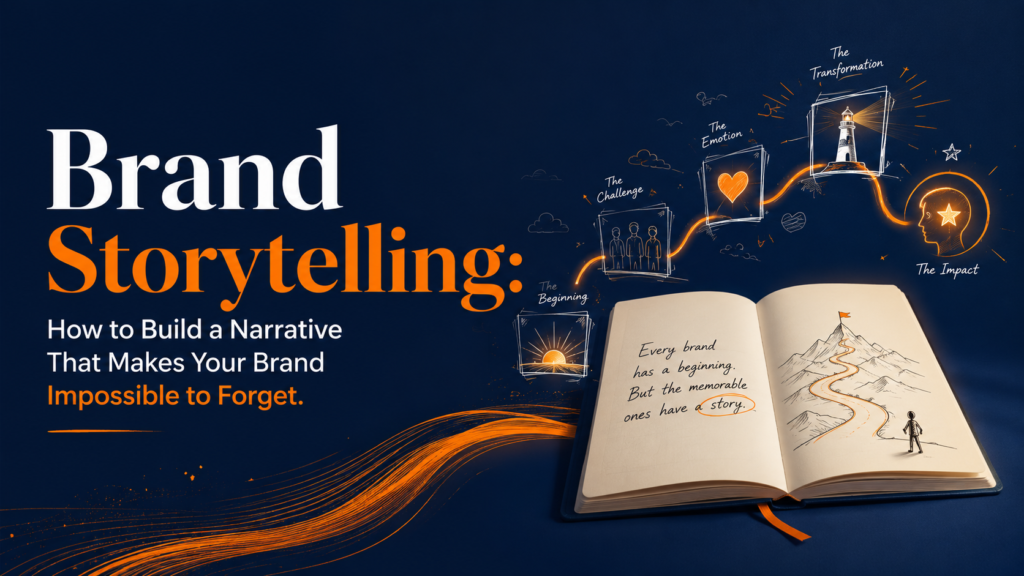
Brand Storytelling: How to Build a Narrative That Creates Loyalty, Drives Word of Mouth, and Outlasts Any Campaign
The most successful brands in the world are not remembered for their features. They’re remembered for their stories. Apple’s story about the rebel who thinks differently. Nike’s story about the athlete inside every human body. Patagonia’s story about protecting the planet they depend on for business. These stories create emotional connections that no product specification can replicate — and those connections drive the purchase decisions, loyalty, and advocacy that determine whether a brand wins or fades.
Brand storytelling is not creating fictions about your company. It’s finding the genuine, true narrative at the heart of your brand — the real reason you exist, the authentic problem you care about solving, the actual people behind the work — and communicating it in ways that resonate emotionally rather than just rationally. When done right, it turns customers into believers and believers into advocates.
This guide explains what brand storytelling involves, the frameworks that structure compelling brand narratives, and how to develop stories that work consistently across every channel your brand uses.
“Marketing is no longer about the stuff that you make, but about the stories you tell.” — Seth Godin
Why Stories Work: The Neuroscience of Brand Narrative
The case for brand storytelling isn’t just intuitive — it’s grounded in how brains process information. When we encounter data and facts, our brains engage the language-processing regions and store the information as data. When we encounter stories, our brains engage multiple regions simultaneously: sensory processing, emotional centers, the motor cortex. Stories produce neurochemical responses — cortisol during tension, oxytocin during connection, dopamine during resolution — that make memories more emotionally vivid and more durable.
This matters for brands because purchase decisions are made primarily by emotional processing, then rationalized by logical processing. The “rational” comparison of product specifications that buyers believe they’re doing is almost always the final step in a decision already made emotionally. Brand stories shape the emotional decision; product specifications provide the rational justification.
The Three Stories Every Brand Must Tell
Story 1: The Origin Story
Why does this brand exist? What problem did the founders experience that nobody was solving? What moment of frustration, insight, or conviction led to the company being built?
The origin story works because it answers the question customers implicitly ask of every brand: “Why should I believe you care about this?” A founder who built a healthcare technology company because they watched a family member navigate a broken system has more credibility than a founder who identified a market opportunity in healthcare technology. Both companies might build identical products, but the origin story shapes how customers receive everything they say.
The origin story should be: true (obviously), specific (not vague), personal (involving real people, not just a company), and connected to the customer problem (the origin should explain why the company understands the customer’s experience).
Story 2: The Customer Story
Who is the customer you serve, and what does your brand make possible for them? This is the story of transformation — the customer before encountering your brand, the challenge they faced, and the changed state your brand helped them achieve.
Customer stories are the most powerful brand asset because they shift the protagonist from the company to the customer. Your brand is not the hero. Your customer is the hero. Your brand is the guide, the tool, the system that equips the hero to overcome their challenge. This framing — borrowed from Joseph Campbell’s Hero’s Journey and adapted by Donald Miller’s StoryBrand framework — is more compelling than any feature-focused narrative because it puts the audience in the center of the story.
Story 3: The Belief Story
What does your brand believe that others in your category don’t? What’s the point of view that drives your product decisions, your culture, your communication? This is the most differentiated story available to most brands because beliefs are harder to copy than products.
HubSpot’s belief that interruption-based marketing was dying created inbound marketing as a category. Basecamp’s belief that software companies shouldn’t optimize for growth at the expense of sustainability shaped an entire product philosophy. These are belief stories that attract customers who share the beliefs and repel customers who don’t — which is exactly how strong positioning is built.
The StoryBrand Framework: A Practical Structure for Brand Narrative
Donald Miller’s StoryBrand framework provides one of the most useful practical structures for brand storytelling. It maps the classic story arc onto a brand communication framework:
The framework’s core insight is that the customer is always the hero. Brands that position themselves as heroes (“We are the best, most innovative, most award-winning”) compete with the customer’s ego. Brands that position themselves as the guide (“We’ve been where you are, and we know the way through”) collaborate with it.
Brand Story Across Channels: Adaptation Without Inconsistency
A brand story’s core narrative should be consistent across every channel — the same beliefs, the same customer protagonist, the same transformation promised. But the expression adapts to each channel’s format, audience, and context.
Finding Your Brand’s True Story
The most common failure in brand storytelling is confusing aspirational stories with authentic ones. A brand’s true story is not what it wants to be perceived as — it’s what is genuinely true about why it exists, who built it, and what it actually delivers for customers. Aspirational fiction doesn’t build trust; authentic truth does.
Exercises for discovering your brand’s genuine story:
The Founding Moment Interview
Interview the founder(s) with questions designed to surface story: What was happening in your life or work when you decided to build this? What did you see that others weren’t seeing? What made you angry, frustrated, or passionate enough to do something about it? What have you sacrificed? What do you believe now that you didn’t believe before you started?
The Customer Journey Audit
Interview your best customers about their story with your brand: What were they struggling with before they found you? How did they feel during that struggle? How did they find you? What was the moment they decided to try? What’s different for them now? What do they tell other people about you?
The Enemy Audit
Every good story has an antagonist. What is your brand fighting against? The status quo your category has normalized that you’re challenging? The assumption your customers have internalized that you’re trying to change? The problem that keeps getting worse because nobody has addressed it properly? The enemy in a brand story is almost always a condition, not a competitor.
Brand Storytelling Mistakes That Undermine Credibility
Making the Brand the Hero
The single most common brand storytelling mistake: centering every story on the brand rather than the customer. “We built the most innovative solution” competes with the customer. “Here’s how Meridian Health solved their retention challenge using our approach” invites identification and aspiration.
Consistency Across Claims
A brand that tells a story of customer-centricity in its marketing but delivers poor customer service in reality creates a trust-destroying gap. Brand storytelling only compounds when the story is consistent with the experience. A story that overpromises accelerates disillusionment rather than loyalty.
Platform-Native Adaptation Failures
Taking a 1,000-word brand story and posting it unedited on Instagram. Recording a 45-minute podcast episode and trying to compress it into a LinkedIn post. Each channel has native story formats. A brand story must be adapted to each channel’s format, not just distributed across all of them.
For how brand storytelling connects to the visual identity that carries the story’s emotional tone, see the brand identity design services guide. For the brand strategy layer that defines the story before it’s told, see the startup branding strategy guide.
Applying Brand Storytelling to Your Content Strategy
Brand storytelling is not a campaign — it’s a content operating system. Every piece of content your brand produces should be traceable to a core story element: it reinforces a belief, advances a customer transformation narrative, or adds depth to the origin story. When this coherence is achieved, the brand’s content library becomes a cumulative body of evidence for the brand’s narrative, rather than a collection of disconnected assets.
For founders building a personal brand alongside their company story, the two narratives should reinforce each other. The founder’s origin story deepens the company’s origin story. The company’s customer success stories validate the founder’s purpose. For how to develop the personal brand dimension, see why founders need personal branding and the personal branding design service.
Tell a Story Worth Remembering
Brand storytelling is the difference between a company that customers buy from and a brand they believe in. The story already exists inside your company — it just needs to be found, shaped, and told with consistency. Let’s find it together.