A Startup Without a Branding Strategy Is Just Guessing
Every design decision, every piece of copy, every color choice either reinforces or undermines something. Companies without a defined branding strategy are making those choices by feel — and feel is inconsistent by nature. What resonates with one team member contradicts what another team member thinks the brand should say. Over time, the accumulation of uncoordinated choices produces a brand that feels scattered, untrustworthy, and forgettable.
A branding strategy solves this by making the rules explicit before the creative work begins. It defines who the brand is for, what it stands for, how it speaks, and how it differentiates from every alternative in the buyer’s consideration set. With a clear strategy, every future decision — a new product page, a social post, a sales deck — gets made faster and produces more consistent results.
This guide explains what a startup branding strategy actually includes, how to build one, and what it enables that operating without one cannot.
“Strategy without tactics is the slowest route to victory. Tactics without strategy is the noise before defeat.”
— Sun Tzu — and one of the most applicable pieces of ancient wisdom for startup brand building
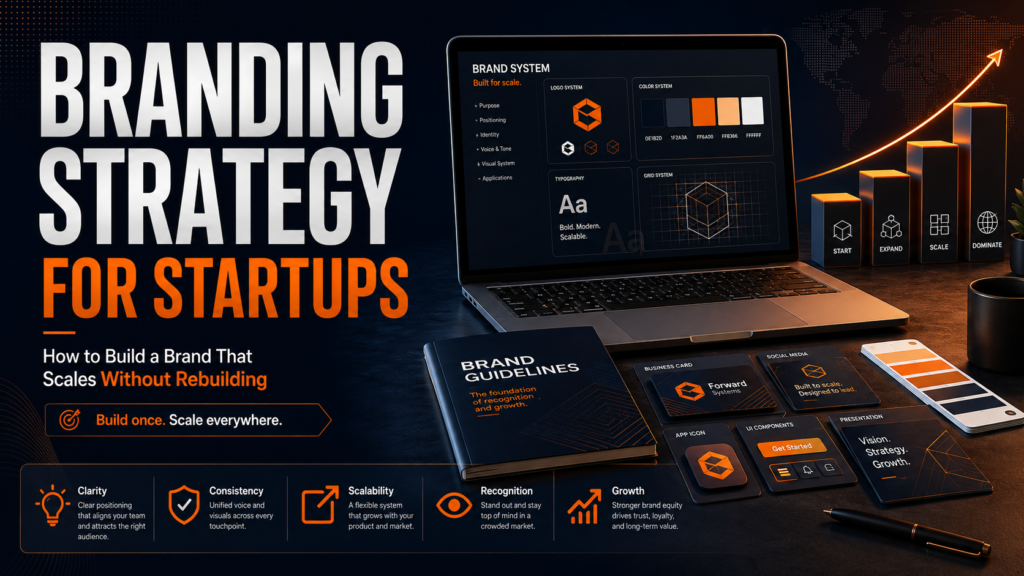
What a Startup Branding Strategy Covers
Brand strategy is often described vaguely — “the thinking behind the brand” — which doesn’t help founders understand what they’re actually building. Here’s the concrete structure of what a startup branding strategy delivers.
Why Most Startup Branding Strategies Fail
They fail for predictable reasons. Knowing them in advance is most of the solution.
Strategy Built Around the Founder’s Taste, Not the Buyer’s Context
A founder who loves minimal, understated aesthetics may instinctively want a brand that reflects those values. But if their buyers are mid-market operations managers who respond to bold, clear, confident visual communication — the founder’s taste actively hurts conversion. Branding strategy must be anchored in how the buyer makes decisions, not how the founder prefers to present.
Positioning That’s Too Broad
Most early-stage startups resist narrow positioning because it feels like it’s excluding potential customers. The opposite is true. A positioning that claims to serve everyone in a broad category is invisible in that category. A positioning that claims to serve a specific segment extremely well becomes the default choice for that segment — and specific segments have referral networks and word of mouth. You grow faster from a clear niche than from a vague generalist claim.
Strategy That Lives in a Document Nobody Uses
A 40-slide brand strategy deck that sits in a Google Drive folder is not a brand strategy — it’s a brand strategy artifact. The strategy only works when it’s translated into practical tools: a one-page positioning cheat sheet, a voice guide with examples, and design guidelines that designers actually reference. Every component of the strategy needs to be operationalized before the document gets filed away.
Copying Competitor Aesthetics
When startups study competitors, they often absorb them. The result is a brand that looks like a variant of whoever is dominant in the category — which is the exact opposite of differentiation. Competitive analysis should reveal where the white space is, not what the template is. If every competitor in your category is dark mode and technical-looking, that’s an argument for being light, warm, and approachable — not for following the convention.
Building a Startup Branding Strategy: The Process
Phase 1: Research (1–2 Weeks)
Effective brand strategy starts with primary research, not assumptions. Talk to ten customers and ten prospects. Ask them: how do they describe the problem your product solves? What alternatives did they consider? What almost stopped them from choosing you? What would they tell a colleague about your company in two sentences? The language customers use to describe your value is often better positioning material than anything the marketing team invents.
Simultaneously, audit the competitive landscape. Collect the homepage headline, the key visual, the color palette, and the dominant tone of voice for each of your top five competitors. This analysis reveals the visual and verbal conventions of the category — and shows clearly where differentiation opportunities exist.
Phase 2: Strategy Development (1 Week)
With research complete, develop the core strategic components. The positioning statement comes first — it anchors everything else. A useful positioning statement follows this structure: “For [specific target customer], [product name] is the [category] that [differentiation claim], because [reason to believe].” This isn’t your tagline; it’s your internal compass.
Brand personality comes next — three to five human attributes that define how the brand should feel. The test for each attribute: if you replaced your brand name with a competitor’s name, would this attribute still apply? If yes, it’s not a differentiator — it’s a category convention. Keep going until you find attributes that are true for you and implausible for your key competitors.
Phase 3: Visual Direction (1 Week)
Before any design work begins, define the visual territory. Collect reference images, color palettes from non-competitive brands, typography examples, and photography styles that embody the brand personality. This moodboard becomes the brief for the visual identity work. A well-built moodboard reduces misalignment between client and designer by 80% — because it makes the aesthetic vision concrete rather than verbal.
Phase 4: Implementation Brief (Ongoing)
The strategy outputs become briefing tools for every future piece of creative work. A content writer receives the voice guide. A designer receives the visual direction and personality attributes. A new sales hire receives the positioning statement and differentiation matrix. The strategy lives in the work, not just the document.
Brand strategy + identity
Strategy before design. Always.
Every branding engagement starts with positioning and differentiation work — so the visual system that follows is built on a foundation that actually converts.
The Branding Strategy Decisions That Compound Over Time
Name Choice
The company name is the first brand decision and one of the hardest to change later. Names that are descriptive (“SimpleBooking”) are easy to understand but difficult to trademark and impossible to own a category with. Names that are invented or abstract (“Slack,” “Stripe,” “Notion”) are harder to explain initially but easier to own, trademark, and build equity in. The right call depends on your category, your timeline to brand recognition, and your international expansion plans — all of which a brand strategy clarifies before the name decision gets made.
Brand Architecture for Future Products
A startup with one product today may have three products in 18 months. A brand architecture decision made now — will future products be sub-brands, variants of the master brand, or independent brands? — affects every product naming, marketing, and design decision going forward. Founders who don’t make this decision early often find themselves with an incoherent brand portfolio that requires expensive restructuring at Series B.
Visual Differentiation from Category Leaders
The first visual decision is the most important: do you look like the dominant players in your category, or do you deliberately look different? Looking like the leader communicates category legitimacy but makes differentiation harder. Looking different communicates distinctiveness but requires more explanation. This is a strategic choice that should be made explicitly, with your target buyer’s psychology in mind — not by default or aesthetic preference.
How Branding Strategy Connects to Business Growth
A strong branding strategy directly affects the metrics founders care about.
Conversion rates improve because positioning clarity reduces buyer uncertainty. When a prospect understands exactly what you do and who it’s for, the qualification happens faster — and qualified leads close at higher rates than confused ones.
Customer acquisition cost drops because consistent, differentiated branding makes every paid and organic channel more efficient. Ads with clear brand identity outperform generic ads. Content that sounds like a distinctive voice builds audience faster than content that sounds like everyone else in the category.
Referral and word-of-mouth increases because customers who can easily articulate what makes your company special can refer with confidence. If even your most loyal customers struggle to explain what you do differently, word of mouth stalls.
The case for building your brand early applies to the company brand as much as it does to personal brand — both compound. A year of consistent, strategically-grounded brand expression is worth more than a rushed rebrand two years in. The same systems thinking that applies to scalable sales infrastructure applies to brand: design the system first, then run the system at scale.
Brand Strategy Frameworks: Which One Works for Early-Stage Startups
Several established frameworks exist for building brand strategy. Understanding what each one is designed to produce helps founders choose the right approach for their current stage and challenge — and helps them evaluate whether a branding partner is using a framework appropriate to the brief.
Brand Positioning Framework (Ries and Trout)
The original positioning framework, developed by Al Ries and Jack Trout, centers on owning a position in the customer’s mind — a specific place in their mental map of the category. The core principle: it’s better to be first in the mind than first in the market. For startups entering an established category, this framework pushes toward a specific differentiated position rather than competing head-to-head on the same attributes as incumbents. The output is a positioning statement that defines the category, the target, the differentiation, and the reason to believe.
Jobs-to-be-Done Brand Positioning (Clayton Christensen)
The JTBD framework reframes positioning around the functional, emotional, and social jobs that customers hire a product to do — rather than product features or category definitions. For early-stage startups, this framework is particularly powerful because it forces the brand to speak to what the buyer is trying to accomplish rather than what the product does. A project management tool positioned as “work better together” (emotional job) outperforms one positioned as “track tasks and deadlines” (functional job) for most buying contexts, because emotional positioning resonates at a higher level of abstraction.
Brand Archetypes (Carl Jung via Margaret Mark)
The archetypes framework draws on twelve universal character types — the Hero, the Creator, the Sage, the Outlaw, and others — to define the brand’s personality at a mythological level. This framework is most useful when the visual and verbal identity needs a strong, emotionally coherent direction. Brands built on a clear archetype tend to have more distinctive voices and visual languages than brands built on functional differentiation alone. The limitation: archetype-based brand strategy is most powerful as a complement to competitive positioning, not a substitute for it.
Brand Essence Wheel (Bates Worldwide)
The brand essence wheel organizes the brand around five concentric layers: attributes (what the brand has), benefits (what it does), values (what it believes), personality (how it behaves), and essence (the single distillation of all of the above). This framework is particularly useful for teams that need to align multiple stakeholders on brand direction — the layered structure makes it easy to identify where different perspectives agree and where they diverge. The output is a one-page visual that serves as a shared reference for all brand decisions.
What Works Best for Startups
For most early-stage startups, the most useful approach combines elements of two frameworks: a JTBD-grounded positioning statement (who, what job, why better than alternatives) and a brand personality definition (what attributes and voice). Together, these answer the two questions that matter most at early stage: why should buyers choose this brand, and what does interacting with this brand feel like? The more elaborate frameworks — full archetype systems, brand pyramids, extended essence wheels — are more useful at Series B and beyond, when the brand is complex enough to need that level of structure.
Build Your Startup’s Brand Strategy Right
Lalit Bahel’s startup branding service is strategy-first: every engagement begins with a positioning and differentiation exercise before any design work begins. The output is a brand that looks distinctive, speaks clearly, and is built to hold up as the company grows — not a brand that needs rebuilding at the next funding round.
Startup branding strategy
The strategy that makes every future design decision obvious.
Positioning, differentiation, brand personality, voice guidelines, and visual direction — built before the logo is designed, so the logo means something.