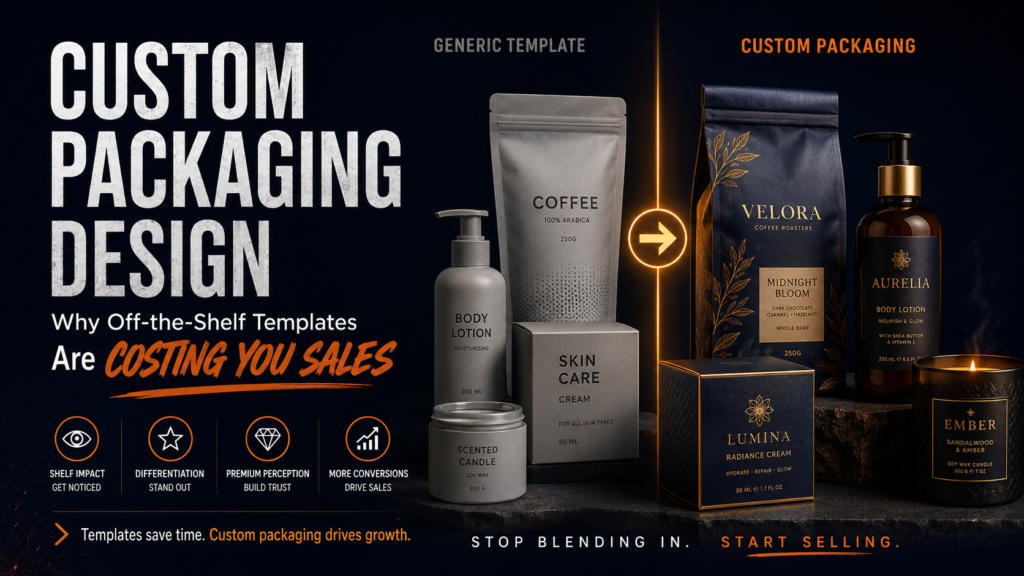
Custom Packaging Design: Why Off-the-Shelf Templates Are Costing You Sales
Generic packaging is invisible. When your product sits on a shelf — physical or digital — surrounded by dozens of competitors, template-based packaging doesn’t just fail to stand out; it actively signals that the brand behind the product didn’t care enough to invest in differentiation. Buyers make that inference faster than they consciously realize.
Custom packaging design is the opposite. It’s a deliberate creative process that starts with a brand, a buyer, and a distribution channel — and builds every element of the package to serve those specific parameters. The result isn’t just packaging that looks better; it’s packaging that converts better, that builds brand recall, and that earns the premium pricing your product deserves.
This guide explains what custom packaging design actually involves, how the process works, what it costs, and how to brief a designer so you get results that hold up in production — not just in a mockup file.
“Packaging is the last three seconds of marketing. Everything you’ve spent on advertising, PR, and social media leads to this moment — and this moment has to close the sale.”
— Phil Dusenberry, ad industry veteran
What “Custom” Actually Means in Packaging Design
Custom packaging design is a specific process, not just a description of a deliverable. The distinction matters because many packaging services sell “custom design” but actually apply templates with color and logo swaps. True custom packaging means the structure, visual system, hierarchy, and finishing treatment are all designed specifically for your brand, your product, and your buyer.
The Custom Packaging Design Process
Phase 1: Discovery and Brief
A custom packaging project starts with questions that don’t feel like design questions. What is the product’s price point — and what does packaging at that price tier look like from the competition? Who is the target buyer, and where are they most likely to first encounter the product? Is this going to a retail shelf, an e-commerce fulfillment center, or being shipped direct-to-consumer? What’s the per-unit production budget?
These constraints aren’t limitations on creativity — they are the brief. Custom design means designing within real constraints rather than ignoring them and producing something beautiful that can’t be manufactured at your cost structure.
Phase 2: Concept Development
The designer develops two or three genuinely distinct visual directions. Not color variations of the same template — fundamentally different approaches to solving the brief. One might emphasize minimalism and premium cues. Another might use expressive illustration and bold color. A third might lean into craft and provenance through texture and typography choices.
Each concept should be shown in photorealistic mockup form — not flat art — so you can evaluate how the packaging will actually look in context, on a shelf, in an unboxing video, or in a product flat-lay photograph.
Phase 3: Refinement
One concept is selected and refined through structured revision rounds. This is where every element earns its place: typography tightens, color gets validated for CMYK reproduction, hierarchy is calibrated for the buyer’s 3-second scan, and finishing options are evaluated against budget. The goal is one excellent, producible solution — not more options.
Phase 4: Technical Production
The finished design is prepared as production files: press-ready CMYK PDFs with bleeds and crop marks, dielines in vector format (.ai or .eps), color profiles matched to the print method (offset, flexographic, or digital), and a separate mockup set for marketing and sales use. A packaging designer who understands production also specifies finishing — lamination type, spot UV placement, embossing, foil — and explains the cost trade-offs of each option.
What Custom Packaging Design Costs
Price variation is driven primarily by three factors: the complexity of the structural design (a simple label vs. a retail display with multiple panels), the number of SKUs in the system, and whether brand identity work is included before packaging begins. Founders who invest in the brand system first — logo, color palette, typography — find that packaging design costs less and moves faster, because the designer isn’t making brand decisions inside the packaging brief.
Custom packaging design
Packaging built for your product — not adapted from a template.
From single-SKU label design to complete product line systems. Print-ready files delivered. No surprises at the printer.
Custom Packaging by Channel: What Changes
Packaging designed for one distribution channel often fails in another. Understanding the channel-specific requirements before the design brief is locked prevents expensive reprints and redesigns.
Retail Shelf
Retail packaging must compete in a dense, fast-moving visual environment. The primary decision-making moment happens in under three seconds, from a distance of two to four feet, surrounded by competitors. Critical design parameters: maximum contrast against category norms, clear benefit hierarchy readable at arm’s length, and structural integrity under the handling of shelf stocking and customer browsing.
E-Commerce and Direct-to-Consumer
E-commerce packaging is evaluated in two separate contexts: as a product thumbnail image on a marketplace listing, and as an unboxing experience when the customer receives the package. The thumbnail context demands packaging that photographs well — clean, high-contrast, legible at small sizes. The unboxing context is an opportunity to reinforce brand values through materials, finishes, and interior design. Custom packaging for DTC brands frequently includes interior print, branded tissue paper, card inserts, and structural opening mechanics designed to create a shareable moment.
Subscription and Wholesale
Subscription packaging is seen repeatedly by the same buyer — which means novelty matters less than quality and brand consistency. Wholesale packaging, shipped in bulk to retailers, needs to survive palletizing and freight handling without damage. Each of these contexts imposes structural requirements that affect the design brief from the start.
Custom Packaging and Brand Identity: How They Connect
Custom packaging is an extension of brand identity — not a parallel creative exercise. The logo, color palette, typography, and visual language defined in your brand identity system should inform every decision in the packaging brief. When the two are developed separately, the result is visual incoherence: packaging that looks like a different brand than the website, which looks like a different brand than the social media presence.
The founders who get this right treat brand identity and packaging as a connected system from the start. The same discipline that builds scalable businesses — invest in the right infrastructure early, execute the system consistently — applies to brand investment. Getting the brand system right before designing packaging means every downstream design decision is faster and more consistent.
If your brand identity needs work before packaging can begin, Lalit Bahel’s brand identity design service delivers the full system — logo, color, typography, and guidelines — that your packaging designer needs to build from.
How to Evaluate a Custom Packaging Designer
The portfolio tells most of the story. Look for:
- Real products in production — not just concept work. Mockups that were never manufactured prove aesthetic skill but not production knowledge.
- Category experience — packaging for food, cosmetics, hardware, and apparel all have different structural conventions, regulatory requirements, and material options. Category familiarity accelerates the brief phase.
- System thinking — projects that show a complete product line (not just a hero SKU) demonstrate the designer can build a scalable system, not just a one-off.
- Production knowledge — ask specifically: “What’s the difference between flexographic and digital printing for this application?” and “How do you handle color consistency between mockups and production?” Answers reveal whether they’ve actually sent files to print or just designed for screens.
Sustainable Custom Packaging Design: Materials, Trade-offs, and What Buyers Actually Notice
Sustainability in packaging is no longer a differentiator for premium brands — it’s a baseline expectation in most consumer-facing categories. Understanding the real options, their cost implications, and what resonates with buyers helps founders make decisions that are both environmentally responsible and financially sound.
Recyclable vs. Compostable vs. Biodegradable: The Distinctions That Matter
These three terms are frequently conflated in brand marketing but describe fundamentally different end-of-life scenarios. Recyclable packaging can be processed through standard curbside recycling programs — but only if the material is accepted in the buyer’s local system, only if the consumer actually recycles it, and only if the packaging doesn’t combine materials (like a plastic window in a cardboard box) in ways that make it non-recyclable. Compostable packaging breaks down in industrial composting facilities within 90 days — but this requires access to industrial composting, which most consumers don’t have. Biodegradable is the least regulated term: most materials are technically biodegradable given enough time, so claims using this word alone are largely meaningless without certification.
Material Options and Their Real-World Trade-offs
What Consumers Actually Respond To
Research on consumer sustainability preferences in packaging consistently shows that the material signal matters more than the certification detail. Kraft paper communicates natural and sustainable even when the product inside isn’t particularly eco-friendly. Matte finishes read as more sustainable than gloss, regardless of the underlying material. Minimal, sparse design reads as less wasteful than ornate, heavily printed packaging. These perceptions are not entirely rational — but they are real and they affect purchase decisions at the shelf. A packaging designer who understands category psychology can build sustainability signals into the visual design even when the material choices are constrained by budget or production requirements.
Certifications Worth Displaying
For brands making genuine sustainability claims, third-party certification provides credible proof and protects against greenwashing allegations. The certifications that carry the most consumer recognition and retailer weight in the US and UK: FSC (Forest Stewardship Council, for paper and board), Rainforest Alliance Certified (for agricultural-input products), and Certified Compostable (BPI in the US, EN 13432 in Europe). Each certification has specific material requirements and licensing costs — building them into the design brief at the start is far less expensive than retrofitting them after the packaging is in production.
Start Your Custom Packaging Project
Lalit Bahel’s packaging design service works with product brands, startups entering retail, and e-commerce companies that want packaging built to convert — not just to look good in a portfolio. Every project starts with a production-aware brief, delivers photorealistic mockups for review, and hands off press-ready files your printer can use without reformatting.
Custom packaging design
Packaging that wins on the shelf, in the inbox, and on camera.
Custom structure, visual design, mockups, and print-ready files — built for your product, your channel, and your production budget.