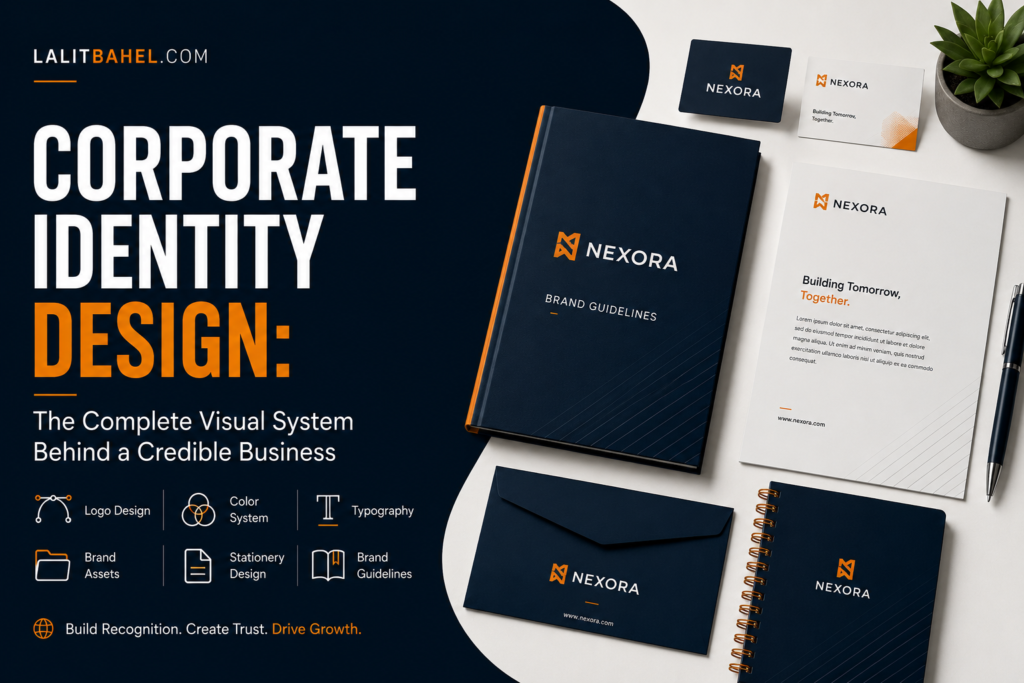
Corporate Identity Design Is Not the Same as a Logo
This is where most businesses misunderstand what they’re buying. A logo is an icon — a mark. Corporate identity design is the complete visual system that determines how a company presents itself across every surface, channel, and context it operates in: business cards, letterhead, email signatures, presentation templates, office signage, vehicle livery, marketing materials, and digital properties. The logo is one element within that system. Identity is the system itself.
Companies that invest in a logo but not a corporate identity end up with a recognizable mark applied inconsistently across everything else. The visual incoherence that results erodes trust in proportion to how many customer touchpoints it affects — which, for a company with multiple physical and digital presences, is a lot.
This guide explains what corporate identity design covers, how the investment pays off across business operations, what the design process looks like when it’s done properly, and how to brief a designer to get a system that actually gets used.
“Corporate identity is the total visual impression a company makes — not just the logo, but every element of communication from business cards to buildings.”
— Walter Landor, founder of Landor Associates and pioneer of corporate identity design
What Corporate Identity Design Includes
Who Needs Corporate Identity Design
Companies Raising Investment
Investors evaluate professional credibility alongside financial opportunity. A company with inconsistent, unprofessional visual identity communicates that the leadership team doesn’t take the business seriously enough to invest in how it presents itself. A polished, coherent corporate identity — reflected across the investor deck, the website, the one-pager, and the founders’ LinkedIn profiles — signals operational maturity before a single number in the model is reviewed.
Companies Entering Enterprise Sales
Enterprise procurement decisions involve multiple stakeholders — not all of whom will see the product demo. Legal, procurement, finance, and IT security reviewers will assess the vendor’s professional credibility through the materials they receive: the proposal, the contract, the security questionnaire response. Visual consistency and professional quality in these documents directly affect the perceived risk of the vendor relationship. Corporate identity design provides the system that makes every document look like it came from the same disciplined organization.
Companies Going Through Rebrand or Merger
When a company changes its name, merges with another entity, or makes a strategic pivot, the visual identity is the most visible signal of that change to customers, employees, and the market. A professionally managed corporate identity redesign — with a clear transition plan for old materials and a consistent rollout of new ones — manages that signal deliberately rather than letting it happen by accident.
Growing Companies Hiring Teams
Every new hire who produces any kind of client-facing content — presentations, proposals, reports — is a brand expression agent. Without a corporate identity system and guidelines, each person makes their own visual decisions, and the accumulated result is a fragmented, inconsistent brand. A clear corporate identity with editable templates removes this problem: every team member can produce on-brand materials without brand approval on each document.
Corporate identity design
One system. Every surface. Consistent every time.
Logo system, color palette, typography, stationery, digital templates, and brand guidelines — delivered as a complete identity system built for enterprise credibility.
The Corporate Identity Design Process
Phase 1: Discovery
Effective corporate identity design starts with understanding the business’s strategic context — not asking for logo preferences. The discovery phase covers: who the company’s primary buyers are, what the company’s competitive differentiators are, what the identity needs to communicate in enterprise contexts, what the existing brand equity (if any) should be preserved, and what channels and surfaces the identity will appear across most frequently.
Competitive analysis is part of this phase. The designer should know what the visual conventions of the industry are — and where there’s opportunity to differentiate. An accounting firm that looks identical to every other accounting firm in its category has missed the opportunity to be the distinctive choice. An identity that’s appropriate for the category while being genuinely distinctive within it is the target.
Phase 2: Concept Development
Two or three logo and identity concepts are developed, each representing a genuinely different strategic direction — not variations on the same idea. Each concept should be shown applied to the primary use cases: business card, letterhead, a digital context (email signature or presentation). This allows the decision to be made on how the identity system works in context, not just how the logo looks in isolation.
Phase 3: System Development
The selected concept is developed into a complete system. This is where the color palette is formalized across all color spaces, the typography is selected and applied with usage rules, the logo variants are created for all contexts (including reversed, one-color, and icon-only versions), and the stationery and digital templates are built out in the selected concept’s direction.
Phase 4: Guidelines and Handoff
The brand guidelines document is built — a master reference that covers every component of the identity with visual examples, do’s and don’ts, minimum size requirements, and usage rules. The complete file set is organized and delivered: master logo files in vector (AI, EPS, SVG) and raster (PNG) formats for every variant, editable template files for all stationery and digital applications, and font licensing documentation for all typefaces used.
Corporate Identity vs. Brand Identity: The Distinction
These terms are often used interchangeably but describe different scopes.
For B2B companies and enterprise-facing businesses, the corporate identity and brand identity are typically unified — the brand is the company. For SaaS companies specifically, the SaaS brand identity system needs to address the corporate identity requirements (professional credibility across sales and procurement touchpoints) and the brand identity requirements (positioning and visual differentiation for buyers who evaluate multiple products) simultaneously.
How Much Does Corporate Identity Design Cost?
The range is wide because scope varies significantly. A minimal engagement might deliver a logo and basic guidelines. A comprehensive engagement delivers a complete visual system with every template, every variant, and detailed guidelines for every application.
- Logo + basic guidelines only: $2,000 – $6,000 — appropriate for very early stage companies that need a starting point and plan to extend later
- Complete corporate identity system: $6,000 – $20,000 — logo system, full color and type, stationery suite, digital templates, comprehensive guidelines
- Enterprise rebrand: $20,000 – $100,000+ — includes large-scale rollout planning, sub-brand architecture, environmental applications, and change management
For growing B2B companies, the investment in a complete corporate identity system pays back quickly through reduced friction in sales processes, improved credibility with enterprise procurement teams, and the elimination of ad-hoc brand decisions by non-designers. The same discipline that keeps high-performing organizations productive at scale — build the right system early, execute the system consistently — applies directly to identity investment.
Corporate Identity Across Every Digital Touchpoint: The Consistency Audit
Most corporate identity failures happen not at launch but in the months after — when team members apply the identity to new contexts without guidance, and the visual consistency that was there at delivery gradually erodes. Running a regular consistency audit across digital touchpoints identifies and corrects these drifts before they compound.
Email and Digital Correspondence
Email is among the highest-frequency corporate identity touchpoints, and among the least consistently managed. Email signatures are typically set up once and never updated when brand guidelines change. HTML emails produced by marketing platforms often drift from brand colors because non-designers use the tools with default color pickers. Transactional emails from product systems frequently use no brand styling at all. A complete corporate identity implementation includes email signature templates in editable HTML format, brand color codes set as defaults in the primary email marketing platform, and at least a basic brand standard applied to product transactional emails.
LinkedIn and Social Media Profiles
The company LinkedIn page, Twitter/X profile, and other social presences are high-visibility brand touchpoints that most organizations treat inconsistently. Profile images, banner images, and the visual style of posted content all communicate corporate identity — or undermine it. A corporate identity implementation should include correctly sized and formatted assets for every active social platform, with notes on update cadence and who is responsible for keeping them current when the brand refreshes.
Presentation Templates
Sales decks, investor presentations, client proposals, and internal all-hands presentations all carry the corporate identity to audiences who matter. Without a master slide template, each presenter makes their own visual decisions — and the cumulative result is a range of presentations that look like they came from different companies. A corporate identity system should include at minimum: a master PowerPoint or Google Slides template with locked brand colors and fonts, a selection of slide layouts covering titles, content, full-bleed visuals, and data tables, and a clear guide on which layouts to use for which content types.
Document Templates
Proposals, contracts, reports, and other formal documents communicate corporate identity to clients, partners, and regulatory bodies. The header and footer treatment, the font and color application, and the cover page design all signal organizational maturity. A corporate identity implementation that includes document templates in Word and Google Docs format — with protected brand elements and editable content areas — ensures that any team member can produce a client-facing document that looks professional and on-brand without any design involvement.
Assigning Identity Ownership
The most consistent corporate identities have a named owner — someone whose job it is to notice when the identity drifts and to correct it. In small companies, this is usually the founder or the marketing lead. In larger organizations, it’s a brand manager or design lead. What matters is that the role exists and is resourced. A corporate identity without an owner is a corporate identity with an expiration date.
Build a Corporate Identity That Commands Credibility
Lalit Bahel designs corporate identity systems for B2B companies, startups entering enterprise sales, and growing businesses that need a professional visual presence that works across every surface. Every engagement includes a strategy phase before any design begins, delivers a complete file set in every format, and produces guidelines that your team can actually use.
Corporate identity design
A complete visual system that makes your company look as good as it operates.
Logo system, color palette, typography, stationery, digital templates, and brand guidelines. Enterprise credibility, consistently applied.