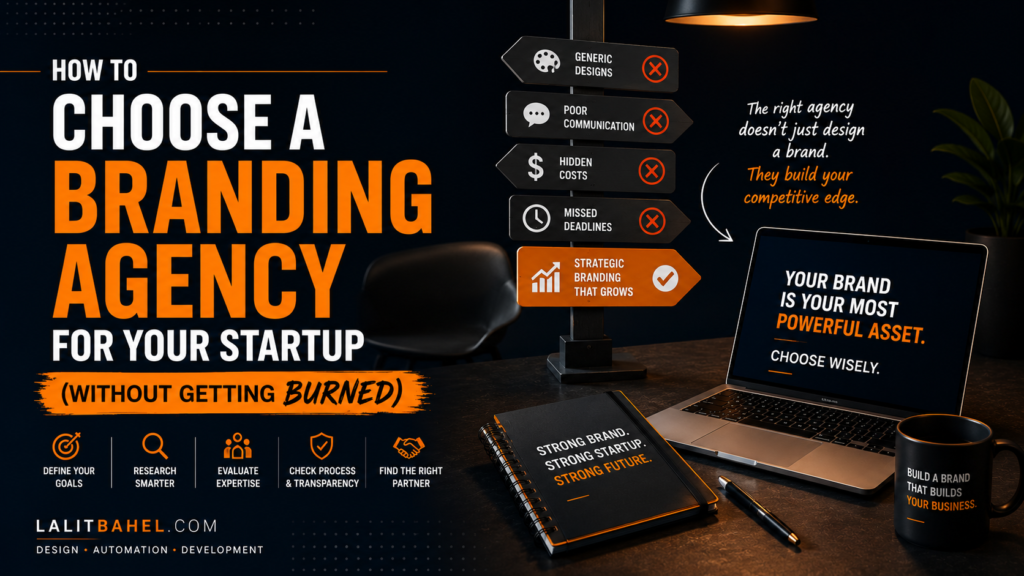
Most Startups Pick a Branding Agency the Wrong Way
They look at portfolios, pick the one that looks most like the aesthetic they want, get a proposal, and hire based on price. Three months later they have a brand that looks nice but doesn’t work — doesn’t resonate with their actual buyers, doesn’t differentiate from competitors, and doesn’t scale when the company grows into new segments or geographies.
Choosing a branding agency for your startup is a strategic decision with a long tail of consequences. The brand you build now will be the one investors evaluate, the one your sales team leads with, and the one that either builds or dilutes trust at every customer touchpoint for the next several years. Getting it right matters. This guide explains how.
“A brand is not what you say it is. It’s what they say it is.”
— Marty Neumeier, brand strategist
Types of Branding Partners Available to Startups
The market for startup branding ranges from solo freelancers to full-service agencies. Each tier serves a different need and comes with different trade-offs.
What a Branding Agency Should Deliver for a Startup
A branding engagement that’s right for a startup delivers a specific scope — not everything a full Fortune 500 rebrand includes, but not so minimal that it breaks in six months. Here’s what the right scope looks like.
Brand Strategy
Positioning, differentiation, target customer definition, and competitive landscape analysis. This is the thinking that makes all the visual work intentional. Without it, you get a brand that looks good but doesn’t say anything specific. Strategy outputs include a positioning statement, brand personality attributes, and a clear “who we are not” definition that helps the design team make choices.
Visual Identity System
Logo (primary, secondary, icon variants), color palette with hex/RGB/CMYK codes, typography (primary and secondary typefaces with usage rules), and iconography or illustration style guidelines. For startups, the visual identity also needs to work natively in digital — which means web-safe fonts, accessible color contrast ratios, and a logo that doesn’t lose its meaning at favicon size.
Brand Voice and Messaging
Tone of voice guidelines, key message hierarchy, and tagline options. This is what gives your future content team, copywriters, and AI tools the parameters to stay on-brand without calling you every time they write something. Strong voice documentation includes concrete examples: here’s how we’d say this on-brand, here’s how we wouldn’t.
Brand Guidelines Document
The master reference document. Covers all of the above with visual examples, do’s and don’ts, minimum size requirements, exclusion zones, approved color combinations, and usage rules for both digital and print. This is the document you hand every future vendor, designer, or employee who touches your brand.
Applied Templates
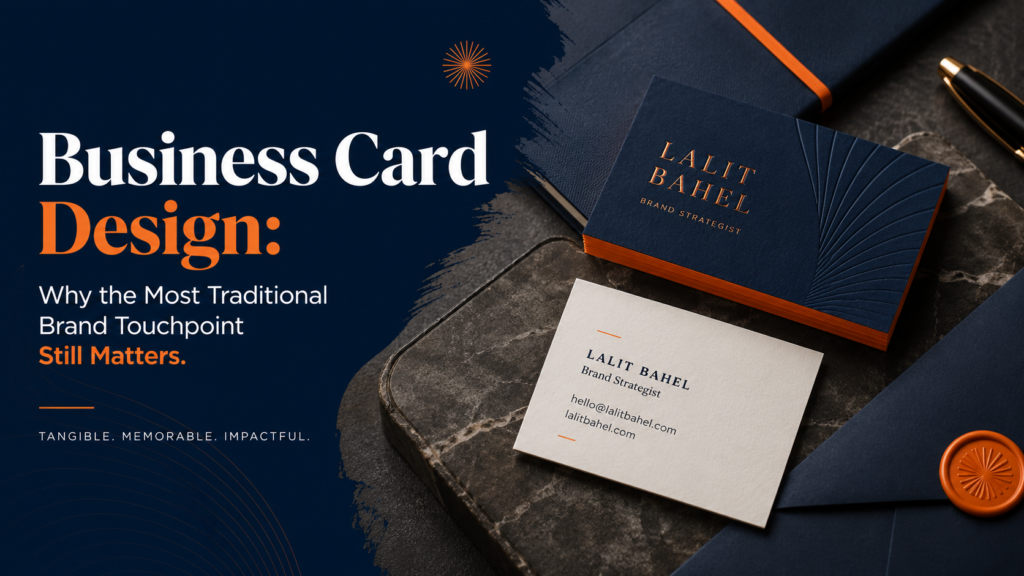
Business cards, email signatures, presentation slide template, LinkedIn banner, and any other immediate-use assets. These convert the guidelines from theory into practice on day one.
Startup branding
Built for startups. Not adapted from agency templates.
Get a brand identity system built for early-stage speed and enterprise-stage credibility — strategy included, templates delivered, guidelines that actually get used.
How to Evaluate a Branding Agency for Your Startup
Most founders evaluate agencies on aesthetics. That’s necessary but not sufficient. Here’s the full evaluation framework.
1. Does the Portfolio Show Strategy, Not Just Visuals?
Any agency can produce beautiful work. The question is whether the work was beautiful because it solved a specific brief, or just because the designer has good taste. Look for case studies that explain: what was the client’s problem, what was the positioning challenge, and how did the design solve it? If the case studies are purely visual showcases without context, the agency likely prioritizes aesthetics over outcomes.
2. Have They Worked in Your Stage?
A branding agency that primarily works with established enterprises will over-engineer a startup brand — delivering a 200-page brand bible when you need a 20-page guide and ready-to-use templates. An agency that works primarily with startups understands that constraints are real: tight timelines, founders who need to be hands-on in the brief, and a brand that needs to work across five channels with a team of three.
3. What Does Their Discovery Process Look Like?
Ask specifically: “What do you need to know before you start any design work?” A strong agency asks about competitive positioning, target buyer psychology, the founder’s vision for where the company is going, and what the brand needs to achieve in 12 months. A weak agency asks about your color preferences and logo ideas. The questions a branding partner asks tell you more about their capabilities than any portfolio.
4. How Do They Handle Feedback?
The revision process is where most branding projects succeed or break down. Ask: how many rounds of revisions are included, and how do they structure feedback sessions? Structured revision rounds with specific scope are a sign of professional process. Open-ended “keep revising until you’re happy” arrangements typically produce decision paralysis and mediocre outcomes.
5. Can They Provide References?
Two or three client references — ideally from companies at a similar stage to yours — are non-negotiable for any significant branding investment. Ask references specifically: did the brand hold up 12 months after delivery? How did the agency respond when feedback was unclear? Would you hire them again?
Red Flags to Watch for in Branding Agency Proposals
Some warning signs are obvious; others only become clear after you’ve signed the contract. Know them in advance.
- No discovery phase. Any agency that proposes to start designing before a structured strategy phase either doesn’t do strategy or is treating your project as a template job.
- Portfolio with only logo presentations. Real brand identity work shows application — websites, business cards, social media, presentations. Logo-only presentations suggest the deliverable may be more limited than you need.
- “Unlimited revisions” policy. This sounds like a benefit but typically signals the opposite: no defined process, no clear decision criteria, and a path to decision paralysis.
- Timeline that’s too fast. A complete brand identity system done properly takes three to eight weeks. Agencies promising a full brand in one week are delivering a logo, not a brand.
- No file handoff documentation. The deliverables should include a clear inventory of every file, what it’s for, and how to use it. If the agency doesn’t commit to this in writing, you may end up with files you don’t know how to use.
“The best brand investment a startup can make is clarity — knowing exactly who you are and who you’re not. Everything else follows from that.”
— Ryan Holiday, author and brand strategist
Branding and Founder Identity: A Special Case
Many startup brands are inseparable from the founder’s personal brand — especially in the early stages when the company’s credibility is borrowed from the founder’s credibility. If you’re the face of the company, your personal brand and your company brand need to work together, not compete. A specialist in personal branding for founders and CEOs approaches this intersection deliberately — designing a personal identity that amplifies the company brand rather than creating a parallel visual system that creates confusion.
The best-performing founder-led companies treat brand as infrastructure, in the same way they treat their CRM, their data stack, or their hiring process. Getting the brand right early means every future team member can produce on-brand work without supervision — and that’s a compounding advantage over companies that are still managing brand inconsistency at Series B.
Questions to Ask a Branding Agency Before You Sign Anything
The proposal looks polished. The portfolio is impressive. Before you sign the contract, these are the questions that reveal whether the agency is actually right for your startup — or just good at selling to startups.
“Walk me through a recent project where the strategy and the client’s initial brief were misaligned. What happened?”
Every experienced branding agency has had a client who came in with a clear vision that turned out to be wrong for the business. How they handled that situation reveals everything about their ability to do the job. A good agency answers this with a specific story: here’s what the client wanted, here’s what we found in discovery, here’s how we navigated the conversation, and here’s what the outcome was. An agency that can’t answer this question probably hasn’t done deep enough strategic work to have ever found that misalignment — which means they execute what clients ask for rather than what clients need.
“Who specifically will be working on our project, and will that change during the engagement?”
Agency bait-and-switch is real and common: senior partners present the pitch, junior designers do the work. Ask for the names and portfolios of the specific designers assigned to your project before you sign. Ask explicitly whether those people will stay on the project from discovery through delivery, or whether staffing changes partway through. The answer tells you whether you’re buying the team that pitched you or a staffing lottery.
“What’s your process for handling disagreements on creative direction?”
Creative disagreements are inevitable. What matters is the process for resolving them. A strong agency has a structured approach: they present the brief rationale alongside the creative, they articulate the strategic reason for every major decision, and they distinguish between feedback that requires a design change and feedback that requires a strategic conversation. An agency that accommodates every client preference without pushback isn’t doing strategy — it’s doing client service. Both have value, but only one produces brand differentiation.
“What does your client onboarding process look like for the first two weeks?”
The first two weeks of a branding engagement reveal how organized the agency’s process is. A clear onboarding — specific questionnaires, a defined discovery session structure, a documented deliverable timeline — signals that the agency has done this enough times to have systematized it. Vague onboarding (“we’ll start by getting to know your business”) signals that each project is built from scratch, which typically means longer timelines and more scope ambiguity.
“Can we speak with two or three clients who were at our stage when they worked with you?”
References from similarly-staged companies are the most predictive indicator of how the engagement will go. Ask specifically: did the timeline hold? How did the agency handle the revision rounds? Was the final brand system actually used by the company, or did it end up on a shelf? Would you hire them again, and if you did it over, would you change anything about how you briefed them? The last question often surfaces the most useful information.
Branding Agency vs. Freelance Brand Designer: How to Choose
The right choice depends on the stage of your company, the complexity of the brief, and how much process overhead you’re able to absorb.
Work With a Startup Branding Specialist
Lalit Bahel works specifically with startups, founders, and B2B companies to build brand systems that are strategically grounded, visually distinctive, and built for the real constraints of early-stage growth. Every engagement includes a strategy phase before any design begins — because the brief determines the result.
Startup branding
A brand that grows with your company — not one you’ll have to rebuild.
Strategy-first. Visual system delivered. Guidelines that get used. Templates ready on day one.