Startup Brand Identity: The System Every Founder Needs to Build Before They Think They’re Ready
Most founders get brand identity wrong in one of two ways. Either they invest in a logo and call it a brand (missing the 90% of the system that makes the logo work), or they delay brand investment entirely because they’re “still figuring out product-market fit” and end up building a brand retroactively, piece by inconsistent piece, as the company grows.
Both approaches are expensive. A logo without a system produces a brand that fragments the moment a second person starts creating content. A brand built retroactively requires expensive remediation: inconsistent materials everywhere, no guidelines to enforce consistency, and the organizational inertia of an existing brand that’s already embedded in hundreds of files and templates.
This guide explains what startup brand identity actually is, why it matters earlier than most founders think, and how to build it systematically—starting with the foundation and building out in the right sequence.
“Your brand is what other people say about you when you’re not in the room. Your brand identity is the system that shapes what they say.” — Jeff Bezos (paraphrased)
What Startup Brand Identity Includes
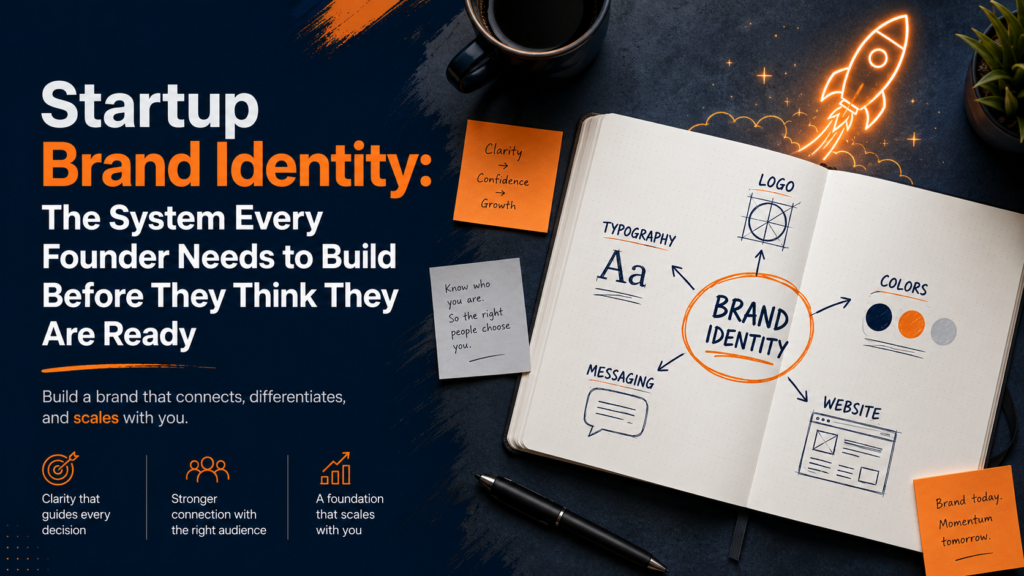
Brand identity is not a single asset—it’s a system. The system has a specific structure, and building it in the right sequence matters.
Layer 1: Brand Strategy (The Foundation)
Brand strategy answers the questions that design cannot answer: Who are we? Who is this for? What do we believe? What’s our positioning in the market? What do we want customers to feel and think when they encounter our brand? Without these answers, every design decision is arbitrary—a guess rather than a choice.
Key strategy components:
- Purpose: Why the company exists beyond making money
- Values: The principles that guide decisions and culture
- Positioning: Where you sit in the competitive landscape and why
- Target customer: Specific description, not demographic approximation
- Brand personality: The human traits and adjectives that describe how the brand sounds and feels
- Brand promise: The specific experience or outcome you guarantee
Layer 2: Visual Identity (The Expression)
Visual identity translates brand strategy into design. Every visual choice—color, typeface, logo form, imagery style—should be derivable from the strategy. When it is, the visual identity feels coherent and intentional. When it isn’t, it feels decorative.
- Logo and logo system (primary mark + variants)
- Color palette (primary, secondary, neutral, and semantic colors)
- Typography system (typeface hierarchy and usage rules)
- Photography and imagery direction
- Iconography and illustration style
- Supporting graphic elements (patterns, textures, shapes)
Layer 3: Verbal Identity (The Voice)
How your brand writes and speaks. Brand voice is one of the most powerful differentiators in the startup world—and one of the most neglected.
- Brand voice characteristics (what’s constant across all communications)
- Tone variations (how voice adapts to different contexts and audiences)
- Messaging framework (the hierarchy of what to say and in what order)
- Taglines and campaign language
- Vocabulary guide (terms used, terms avoided)
Layer 4: Brand Guidelines (The Rules)
The documentation that enables consistent application of all three layers above across every team member, vendor, and context.
When to Invest in Startup Brand Identity
The common mistake is using “we don’t know our customer yet” as a reason to avoid brand investment. A startup that doesn’t yet know its customer still knows what it’s building and what it believes. A brand built on those foundations can evolve as customer understanding develops—it’s much harder to build a brand on no foundation at all.
The Startup Brand Identity Design Process
Week 1–2: Strategy Sprint
A structured conversation (or series of conversations) to answer the brand strategy questions. The output is a one-page brand strategy document: purpose, positioning, personality, target customer, and brand promise. For startups that have been operating without explicit strategy, this phase often surfaces misalignment between founders that’s valuable to resolve before it embeds in the design.
Week 2–4: Visual Identity Development
Logo concepts developed from the brand strategy brief. Two to four distinct directions presented with rationale: why this direction, what it communicates, how it maps to the strategy. Each direction shown in context—website header, business card, social profile—not just as a floating logo on white background.
Week 4–6: System Build
Selected direction refined to final quality. Full color palette specified (hex, RGB, CMYK, Pantone). Typography hierarchy defined and documented. All logo variants produced. Supporting graphic elements developed. Photography direction defined. Initial templates built (presentation, business card, email signature).
Week 6–7: Guidelines Documentation
Brand guidelines document produced: logo usage rules, color specifications, typography hierarchy, imagery direction, clear space and minimum size requirements, prohibited uses, and file format reference. The guidelines should be findable by anyone on the team and specific enough that a new designer could apply the brand correctly without verbal briefing.
For more detail on what goes into brand identity design at the startup stage, see the brand identity design services guide. For how the visual identity integrates with the startup’s pitch and investor materials, see how to choose a branding agency for your startup.
Common Startup Brand Identity Mistakes
Logo First, Strategy Never
The most common startup branding mistake: commission a logo from a Fiverr designer, decide on colors based on personal preference, choose a typeface because it came with a website template, and call that a brand. The result is a visual identity that doesn’t cohere because there’s no strategic foundation connecting the design decisions. Every piece was chosen for a different reason, by a different person, at a different time.
Confusing Brand with Logo
A logo is a mark. A brand is an entire experience system. When a startup says “we need to work on our brand” and then commissions a logo update without addressing voice, messaging, photography, or guidelines, they’ve treated the symptom without diagnosing the disease.
Building for Today, Not for Tomorrow
A startup brand identity built exclusively for the current product, current team, and current customers may not scale as the company grows. The best startup brand identities are built with intentional future-proofing: a color system that expands gracefully, a logo that works at any size and on any surface, a voice that matures without requiring a reinvention.
No Design System for the Product
For tech startups especially, the product interface is the most experienced brand touchpoint. A brand identity that doesn’t translate into a product design system creates a disconnect between marketing and product—two different visual languages applied to the same company. The brand identity and the product design system should be built together, or at minimum in close coordination.
Measuring Startup Brand Identity Effectiveness
Brand identity effectiveness is harder to measure than performance marketing, but not impossible. Indicators worth tracking:
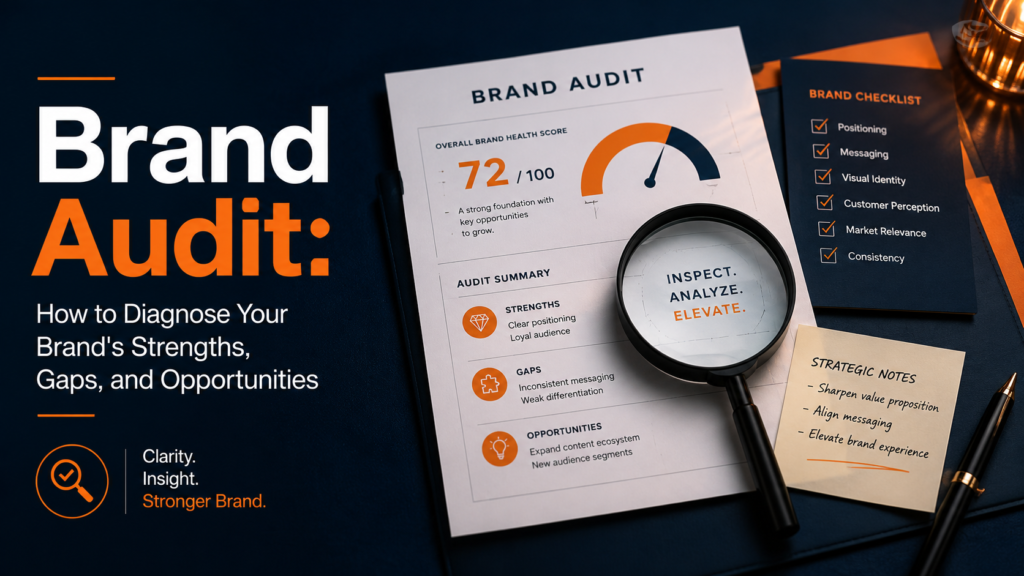
- Consistency audit: Does your brand look the same across your website, social media, sales deck, product, and email? Regular internal audits catch drift before it compounds.
- Customer recall: Can customers describe your brand without looking at your materials? Unaided brand recall measures how distinctively your identity has registered.
- Investor and partner feedback: After early meetings, what impression did the visual identity create? This feedback surfaces issues before they’re embedded at scale.
- Team alignment: Can every member of the team articulate the brand’s purpose, personality, and visual rules? Team alignment is a leading indicator of external consistency.
Brand Identity and Startup Fundraising
There is a documented, if informal, correlation between presentation quality and fundraising success. Investors who see hundreds of pitches every quarter apply quick pattern-matching to determine which opportunities merit deeper attention. A polished, coherent brand identity is a positive signal in that pattern-match: it says the team executes, pays attention to detail, and has thought about how the company will present itself to customers.
This doesn’t mean investors fund companies based on design quality. It means that brand identity creates a halo effect on perception that reduces skepticism and makes the content of the pitch easier to receive. A presentation that looks sloppy creates cognitive overhead that a polished presentation doesn’t. For founders raising capital, removing that overhead is worth the investment in brand identity.
For personal branding that complements the company brand for founder-led fundraising, see the personal branding service for founders and CEOs. For the complete startup design ecosystem, explore the startup-focused design services.
Build a Brand Identity That Grows With Your Startup
A startup brand identity built on the right foundation—strategy, then visual identity, then guidelines—creates consistency that compounds over time. Every investor presentation, every customer touchpoint, every team member who creates content is working with the same system and building the same brand. That compounding is one of the highest-ROI investments a startup makes.