B2B Branding: Why It’s Harder Than Consumer Branding and How to Get It Right
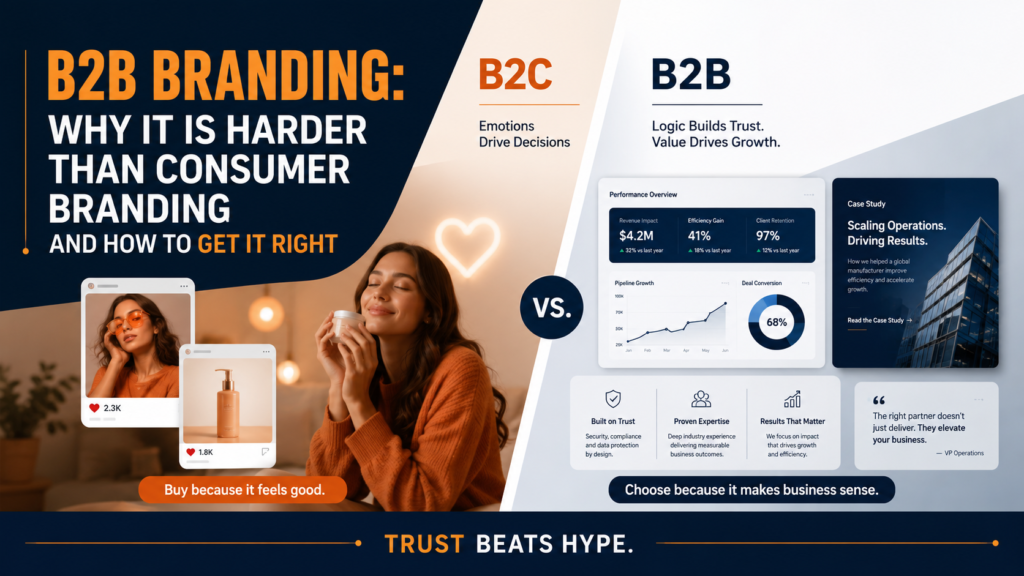
B2B branding is fundamentally different from consumer branding, and most B2B companies get it wrong in the same predictable ways. They default to “professional” visuals that look exactly like their competitors. They write copy that describes features rather than outcomes. They build brands for procurement managers when the actual buyers are department leaders who care about career risk and peer credibility.
The result is a sea of blue-and-gray tech company websites with identical stock photography of people in glass-walled offices, all saying some variation of “the platform that scales with your business.” Nobody stands out. Nobody is remembered. And the companies that do break through—not because their product is dramatically better, but because their brand creates enough differentiation to start conversations in a crowded category.
This guide explains what B2B branding actually is, why the standard playbook produces mediocre results, and what separates the B2B brands that win from the ones that compete on price.
“In B2B, you’re not just selling to companies. You’re selling to people inside companies who have careers to protect and bosses to answer to. Your brand needs to reduce their perceived risk, not just communicate your features.” — Byron Sharp, How Brands Grow
What Makes B2B Branding Different
Longer Sales Cycles
A consumer purchase decision for a $50 product takes minutes. A B2B purchase decision for a $50,000 annual software contract takes months—sometimes more than a year for enterprise deals. Your brand needs to create and maintain consideration across a much longer decision window. That means thought leadership, content, consistent presence, and a brand that compounds recognition over time rather than driving immediate purchase.
Committee Buying Decisions
The average B2B technology purchase involves 6–10 decision-makers, according to Gartner research. Your brand isn’t being evaluated by one person—it’s being discussed in meetings, shared in Slack channels, and compared in spreadsheets by people who have never met each other and may have conflicting priorities. A strong brand creates the social proof and credibility that makes it easier for your champion to sell you internally.
Risk Aversion
In consumer purchases, a bad decision costs money. In B2B purchases, a bad decision costs a career. The professional risk attached to a B2B buying decision means that trust and credibility carry far more weight than they do in consumer contexts. Your brand needs to reduce perceived risk as much as it communicates benefit.
Relationship Value
B2B brands are evaluated not just on what they sell but on what it will feel like to work with them. The quality of your case studies, the responsiveness of your communication, the clarity of your documentation, and the professionalism of your team’s LinkedIn presence all contribute to brand perception in ways that have no consumer parallel.
The Three Layers of B2B Branding
Layer 1: Corporate Brand
Your company identity—who you are, what you stand for, and why that matters. This includes your visual identity (logo, color, typography, imagery direction) and your verbal identity (brand voice, core messages, positioning statement). The corporate brand is the foundation that everything else builds on.
Layer 2: Product/Service Brand
The specific identity of what you sell. In multi-product companies, individual products often have their own names, visual treatments, and positioning. The product brand lives within the corporate brand system but may have specific elements tailored to its target buyer and use case.
Layer 3: Personal/Expert Brand
In B2B, the personal brand of founders, executives, and subject matter experts is a significant brand asset. Buyers research the people behind the products. A CEO with a strong LinkedIn presence and genuine thought leadership creates B2B brand value that no amount of advertising can replicate. This is especially true for professional services firms, consultancies, and agencies.
For the personal branding component, see how personal branding for founders and CEOs integrates with corporate brand strategy.
B2B Brand Architecture Models
How you organize your brands relative to each other matters as much as how you design each one. B2B companies face specific brand architecture choices as they grow:
Most early-stage B2B companies should default to a monolithic approach: one brand, all products under it. The complexity and cost of managing multiple brands is rarely justified until significant scale.
B2B Brand Positioning: The Framework That Works
Brand positioning for B2B requires precision. The positioning statement format that tends to produce the clearest results:
For VP of Sales at mid-size SaaS companies who lose deals because buyers cannot justify ROI to their CFO, Truemetric is the revenue analytics platform that turns product usage data into boardroom-ready business cases, because it pulls insights from 200+ enterprise deployments rather than generic benchmarks.
Every element matters:
- Target buyer role — not “mid-market companies” but “Head of Operations at Series B SaaS companies”
- Specific problem — not “inefficient processes” but “manually reconciling three different data sources every week”
- Category definition — the competitive set you’re placing yourself in (or consciously opting out of)
- Specific outcome — not “improve efficiency” but “reduce reconciliation time from 8 hours to 30 minutes”
- Reason to believe — the evidence that makes the outcome claim credible
The discipline of filling in this template forces specificity that generic B2B branding consistently avoids. Specificity is what makes a B2B brand memorable and trustworthy.
Visual Identity for B2B Brands
B2B visual identity has a specific challenge: it needs to signal professionalism (a baseline requirement) while still creating the differentiation that makes you memorable in a category full of professional-looking competitors.
The most common failure mode is designing for “professional” and stopping there. The result is a visual identity that your audience reads as “competent but forgettable”—which means you’ll win on price or relationship, not on brand.
Color Strategy in B2B
Blue dominates B2B technology branding so thoroughly that choosing an unusual color—teal, orange, purple, warm red—can create significant differentiation by itself. The category convention exists because blue signals trust and authority; the opportunity exists because every brand in your space has already made the same choice.
A differentiated color choice works when it can be justified by something beyond “we wanted to stand out.” It should connect to a genuine brand story: why this color, for this company, for this customer. A warm orange for a B2B company whose whole positioning is about human-centered implementation makes strategic sense. A random purple because blue felt boring does not.
Typography in B2B Visual Identity
B2B brands have more latitude with typography than consumer brands, because their audiences are reading longer content and evaluating more complex claims. Typography choices should balance legibility with personality: a geometric sans-serif signals precision and modernity; a humanist sans-serif signals approachability and partnership; a transitional serif signals heritage and expertise.
Photography and Imagery Direction
The biggest opportunity in B2B visual identity is photography. Most B2B companies use identical stock photography—glass offices, people in meetings, hands on laptops. Custom photography or a highly distinctive stock photography direction can create massive differentiation at relatively low cost.
The direction should be tied to the brand’s positioning. A company positioning itself as “the human alternative to enterprise software” should show real people in real environments. A company positioning itself as “the precision tool for data teams” should show clean, technical environments with a focus on detail and clarity.
For a complete approach to B2B brand identity design for software companies, the SaaS brand identity design service covers the specific requirements of technology company branding. For strategy context, see the branding strategy guide.
B2B Content and Thought Leadership as Brand Assets
In B2B, content is branding. The quality of your research reports, the depth of your technical documentation, the insight of your executive commentary, and the usefulness of your educational resources all build brand equity in ways that traditional advertising cannot.
The B2B brands that dominate their categories often do so through content that buyers genuinely find valuable—not marketing that buyers scroll past. Gartner built an entire business model on this insight. HubSpot turned inbound marketing content into one of the most recognized B2B brands in the world.
The specific B2B content formats that build brand equity:
- Original research — Proprietary data that buyers cite and share
- Technical depth — Documentation, guides, and tutorials that demonstrate genuine expertise
- Executive perspective — Opinion pieces and commentary from company leaders that take genuine positions
- Customer success stories — Detailed case studies that describe specific challenges, approaches, and measurable results
- Benchmark reports — Category-level data that establishes the company as a knowledge authority
B2B Brand and the Sales Process
In B2B, the gap between marketing brand and sales experience is a critical vulnerability. Buyers who encounter a polished, premium brand in marketing and then receive a poor sales experience—generic demos, slow follow-up, salespeople who don’t understand their business—suffer a brand confidence collapse that is very difficult to recover.
B2B brand strategy must extend into the sales experience. The deck used in sales calls, the quality of the proposal, the design of the contract and onboarding materials, and the responsiveness and sophistication of the sales team are all brand expressions. A strong marketing brand with a weak sales brand is a leaky funnel with an attractive entrance.
Measuring B2B Brand Effectiveness
B2B brand is notoriously difficult to measure because its effects are long-cycle and indirect. That difficulty has led many B2B companies to underinvest in brand and over-invest in performance marketing—a strategy that produces predictable short-term lead volume but structural weakness in categories that require differentiation for premium pricing and market leadership.
Metrics worth tracking for B2B brand:
- Aided and unaided brand awareness — Do target buyers know you exist?
- Share of voice — How much of the category conversation do you own?
- Branded search volume — How many people are searching for your company by name?
- Sales cycle length — Strong brand shortens sales cycles by reducing the time required to establish trust
- Win rate against named competitors — Are you winning more often against specific brands?
- Net Promoter Score — Do current customers actively recommend you?
If you’re building a B2B brand and want to ensure the visual identity, positioning, and brand system all align, explore the branding and identity design service or read more about what a brand identity design engagement includes.
B2B Brand That Differentiates and Converts
In B2B, the brands that win are the ones that create genuine differentiation in categories where everyone looks the same. The right visual identity, positioning, and brand system can transform how buyers perceive you—and what they’re willing to pay.