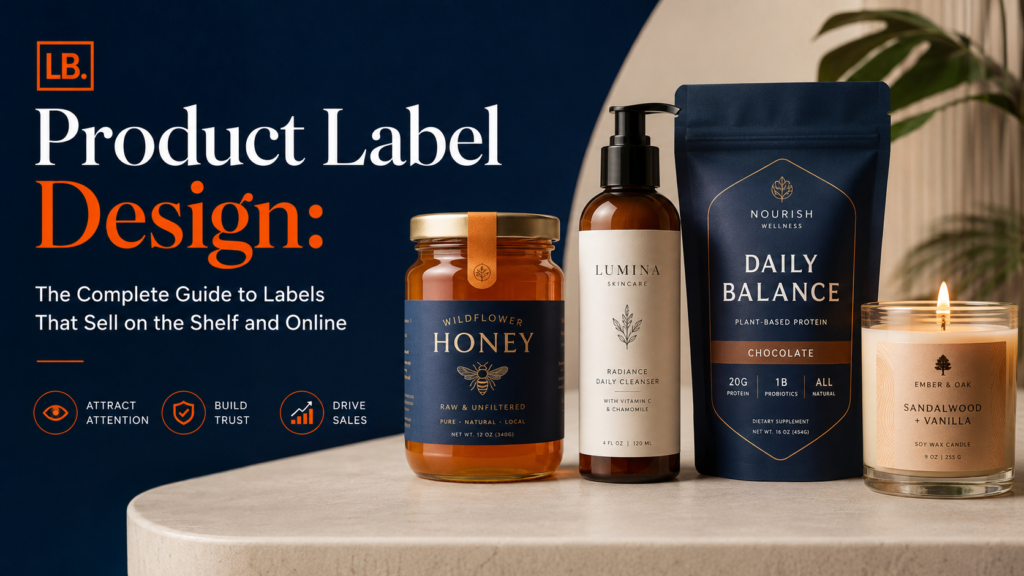
Product Label Design: The Complete Guide to Packaging Labels That Sell on the Shelf and Online
Your product label has approximately two seconds to make an impression on a shelf or in a product thumbnail image. In those two seconds, it communicates whether your product belongs in the category your customer is shopping, whether it’s positioned at the price point they’re willing to pay, and whether it’s trustworthy enough to pick up and read further. Everything else—features, ingredients, story—happens only if the label passes the two-second test.
This is why product label design is one of the highest-leverage design investments a product company can make. The label is the physical representation of the brand, delivered directly to the customer at the moment of decision. It’s also one of the most technically complex design disciplines: labels must balance brand expression, regulatory compliance, production constraints, and retail/e-commerce performance requirements simultaneously.
This guide covers what professional product label design includes, the key decisions every product brand must make, how the design process works, and how to avoid the mistakes that cost brands shelf space and conversion.
“On the shelf, you have less than three seconds to communicate who you are, what you offer, and why you’re different. Every millimeter of label space is either working for you or against you.” — Packaging designer principle
The Four Jobs of a Product Label
Job 1: Attract Attention
The label must stop the eye. In a category where dozens of similar products sit side by side, the label that attracts attention first earns the consideration that can lead to purchase. Attention is captured through visual contrast (color, form, or type treatment that stands out against shelf context), visual novelty (something unexpected that triggers curiosity), or category authority (a design so confident and well-crafted that it reads as the category leader).
Job 2: Communicate Identity
Once attention is captured, the label has seconds to communicate what this product is, who it’s for, and why it matters. Category placement (the visual signals that say “this belongs in the premium skincare section” or “this is an energy drink”), brand personality (premium or accessible, serious or playful, natural or technological), and core value proposition all need to register quickly, before a customer consciously decides to read the label.
Job 3: Communicate Information
Every product category has mandatory labeling requirements: ingredient lists, nutritional information, safety warnings, country of origin, net weight, manufacturer details, certifications. This information must appear clearly and legibly while competing for space with brand expression. Navigating this tension is one of the core design challenges of label work.
Job 4: Survive the Journey
Product labels encounter physical stress: shipping, retail handling, temperature changes, moisture exposure, and consumer handling. The material, adhesive, and print specifications of a label must match the conditions it will face. A beautiful label that peels, fades, or smears in transit or use is a brand liability.
Types of Product Labels
Key Design Decisions in Product Label Design
Label Format and Shape
Label shape and dimensions are constrained by the container they’ll be applied to, but there’s more flexibility than most brands assume. Non-standard shapes (die-cut labels that echo the product form, wraparound panels that create visual continuity, multiple-panel designs that invite exploration) can create significant differentiation at the shelf level.
Color Strategy for Labels
Label color faces a specific challenge that digital design doesn’t: color accuracy varies by print method, material, and surface. A color that looks perfect on a digital proof may print differently on a paper label, a foil label, and a clear label. Label design must be specified for production as much as for aesthetics.
Category color conventions also apply: natural and organic food products cluster around earthy greens and neutral tones; premium spirits use black, gold, and dark navy; consumer health products use clinical white with restrained accent color. Understanding where your category clusters helps you make an intentional decision: align with convention (for the trust signal) or differentiate (for the attention signal).
Typography for Labels
Typography on product labels must work at very small sizes. Required regulatory text is often at 8–9 point or smaller. Even primary brand text is often rendered at sizes where subtle typographic quality—letter spacing, weight contrast, serif structure—significantly affects legibility and perceived quality. Type choices for label work require testing at actual production size, not just at screen size.
Specialty Print Techniques
Specialty finishes can significantly elevate label appearance and brand perception:
- Foil stamping: Metallic gold, silver, or colored foil for premium signals
- Embossing / debossing: Raised or recessed elements that add tactile dimension
- Spot UV: Gloss coating over specific design elements for contrast
- Soft-touch lamination: Matte texture that feels premium in hand
- Textured substrates: Paper stocks with cotton, linen, or wood-feel textures
Each technique has production cost implications and minimum order quantities. The designer must specify them with the production context in mind, not just the aesthetic preference.
Regulatory Requirements by Category
Label regulatory review should happen before design finalization, not after. A designer who completes a label without accounting for mandatory content requirements will produce work that needs significant revision. Brief the designer on your regulatory requirements in the initial project brief.
E-Commerce Label Design Considerations
Products sold primarily online face different label performance requirements than retail products. The primary impression surface is not a physical shelf—it’s a 200×200 pixel product thumbnail on Amazon, Shopify, or the brand’s website. The design hierarchy that works at retail scale may not communicate at thumbnail scale.
E-commerce label design principles:
- Main display panel optimized for thumbnail: The primary visual—brand name, product name, hero visual—must be legible and impactful at 200px
- High contrast: Fine details that read well in person become unreadable in compressed thumbnails; high contrast between key elements is essential
- Simple form: Complex illustrated labels that look premium in hand can look busy and unclear in thumbnails; testing at actual thumbnail dimensions is essential
- Lifestyle photography strategy: E-commerce products often supplement label photography with lifestyle imagery; the label design should support this photography direction
For packaging design that extends beyond the label to the full container and unboxing experience, see the packaging design service and the detailed guides on packaging design services and custom packaging design.
The Product Label Design Process
Phase 1: Discovery and Brief (Week 1)
The designer needs to understand: the product and its key differentiators, the target customer and their purchase context (where does shopping happen?), the container type and dimensions, regulatory requirements, production method and print vendor, distribution channels (retail, e-commerce, both), and the budget range for specialty finishes.
Phase 2: Concept Development (Week 1–2)
Two to three distinct label concepts developed showing different visual approaches to the brand and product. Concepts should be presented in realistic mockup form—on the actual container type, in a retail or e-commerce context—not as flat label artwork in isolation. Context shows how the design will actually perform.
Phase 3: Refinement and Regulatory Review (Week 3)
Selected direction refined. Regulatory text and required content incorporated. Label reviewed by the brand’s legal or regulatory advisor for compliance. Design adjusted as needed.
Phase 4: Production Specification (Week 3–4)
Print-ready files produced: correct color profiles (CMYK or Pantone specification), proper bleed and safe zones, die-cut shape specification if applicable. All specialty finish elements isolated on separate layers with instructions for print vendor.
Phase 5: Proof and Approval
A physical proof from the print vendor should be approved before final production runs. Color, finish, and adhesive performance should all be verified against physical samples before committing to a print run.
What Label Design Costs
Production costs (printing) are separate from design costs. A premium label with foil and embossing may cost $0.80–$2.50 per unit at 5,000 units vs. $0.10–$0.30 for a basic paper label. The design investment and production investment should be considered together.
For questions about your specific label project—whether it’s a new product launch or a redesign of an existing line—reach out with your product and packaging details.
Your Label Has Two Seconds. Make Them Count.
Product label design is where brand strategy meets regulatory compliance meets production reality. The best label designs solve all three simultaneously—attracting attention, communicating identity, and surviving the production and distribution journey. Let’s design yours.