Packaging Is the Last Ad Your Customer Sees Before They Buy
Before someone reads your email sequence, before they watch your product demo, before they even fully understand what you sell — they’ve already judged your packaging. That judgment takes about 90 milliseconds. It’s not conscious. It’s pattern recognition: does this look like something worth buying?
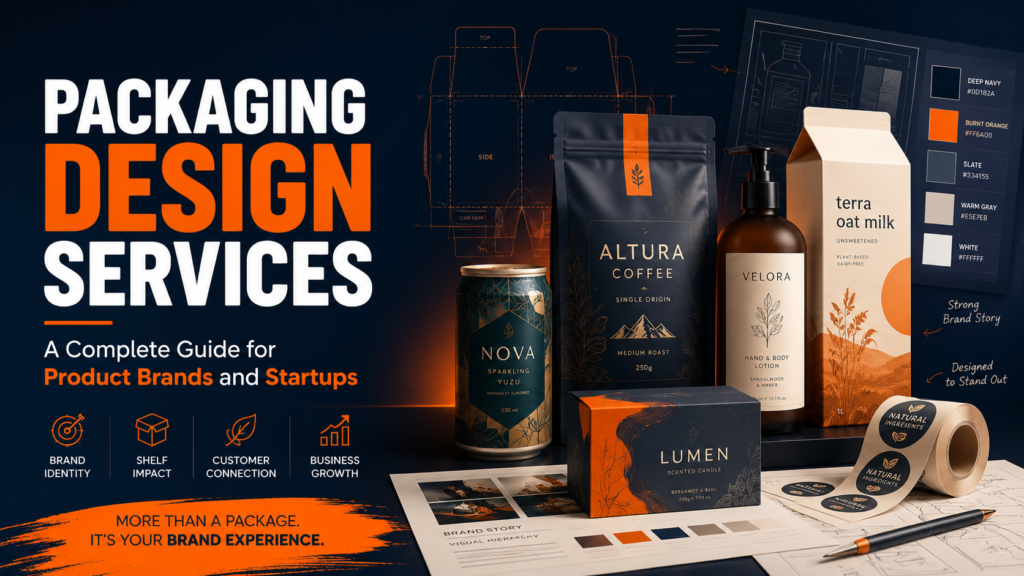
Packaging design services exist precisely because that judgment is high-stakes and most founders underestimate how much it influences the rest of the customer journey. A product on a shelf or in an unboxing video is competing with everything else in that visual field. Great packaging wins that competition before a single word gets read.
This guide breaks down what professional packaging design services actually include, how much they cost, how to brief a designer properly, and the mistakes that cause companies to redo their packaging six months after launch.
What Packaging Design Services Cover
The scope varies by agency and project, but a complete engagement typically delivers more than just a visual design. Here’s what to expect from a professional packaging design service.
“Packaging is the silent salesman. It must communicate the brand promise, the product benefit, and the emotional reward — all in the three seconds a shopper gives it.”
— Marty Neumeier, brand strategist and author of The Brand Gap
The Business Case for Professional Packaging Design
Good packaging design isn’t a cosmetic choice — it directly affects conversion, retention, and average order value. Here’s how.
Shelf Conversion
Studies on consumer packaged goods consistently show that packaging accounts for 30–40% of purchase decisions made at point of sale. When two products with similar quality and price sit next to each other, the one with cleaner, more credible packaging wins the sale the majority of the time. Professional packaging design services optimize for exactly this moment.
Unboxing and Social Sharing
For e-commerce brands, the unboxing experience is the product experience. A package that looks like it was designed with care communicates that the product inside was made with care. The inverse is equally true. Brands that treat packaging as an afterthought typically see lower repeat purchase rates — not because the product is worse, but because the first physical encounter didn’t build enough trust to guarantee a second order.
Retailer Acceptance
Getting onto retail shelves requires more than a good product. Buyers at grocery chains, specialty retailers, and pharmacy chains evaluate packaging for brand maturity, shelf readiness, and category fit. Many promising products get rejected not because the product fails but because the packaging doesn’t look like it belongs in the store. Professional packaging design is often the difference between a listing and a rejection.
Premium Pricing Power
Pricing power comes from perceived value. Packaging is one of the fastest ways to shift perception. A product in well-designed, high-quality packaging can command a 20–40% price premium over an identically formulated product in generic packaging. That’s not manipulative — it’s the market’s accurate valuation of the experience the brand has created.
Types of Packaging Design Projects
Not all packaging design work is the same. Understanding which category your project falls into helps you brief a designer correctly and set realistic expectations for scope and cost.
New Product Launch
A brand launching a product for the first time needs both structural and visual design from scratch. This is the most comprehensive scope — the designer needs to understand your brand system, your target customer, your distribution channel (retail vs. e-commerce vs. both), and your production budget before making any design decisions.
Brand Refresh
An existing product getting updated packaging. The structural work may already be done; the visual design is the focus. Common triggers: rebranding the parent brand, moving into a new retail channel, or modernizing packaging that has aged poorly compared to newer competitors.
Line Extension
Adding new SKUs to an existing product line — new flavors, sizes, or variants. The design system already exists; the work is applying it correctly to new configurations while maintaining shelf cohesion and differentiating clearly between variants at a glance.
Limited Edition / Seasonal
Temporary packaging for campaigns, holidays, or collaborations. These projects require the design to feel fresh and special while still being instantly recognizable as the core brand. The tension between novelty and consistency is what makes limited edition packaging a specialist skill.
Get a packaging design quote
Ready to make your product impossible to ignore on shelf?
Share your project brief and get a clear scope and price within 48 hours. No retainer, no vague estimates.
How Much Do Packaging Design Services Cost?
Pricing depends heavily on complexity, number of SKUs, and whether structural design is included alongside visual design.
Founders scaling their physical product business from early traction to retail distribution often find that packaging is one of the highest-leverage investments they make — the same operational discipline applies here: get the system right early so you’re not rebuilding under pressure later.
The Packaging Design Process Step by Step
Step 1: Discovery and Brief
A strong designer starts by asking hard questions. What distribution channel is this product targeting — retail shelf, e-commerce, direct-to-consumer subscription? What is the price point, and what does packaging at that price tier look like from competitors? Who is the target customer, and what do they care about when they evaluate this category? What production budget is allocated for the physical packaging per unit?
These aren’t administrative questions — they are design constraints. Packaging that looks beautiful but costs $4 per unit when the budget is $1.20 is a failed design. The brief locks in constraints before creative exploration begins.
Step 2: Concept Development
The designer develops two or three distinct visual directions. Not color variations of the same idea — genuinely different approaches to solving the brief. One direction might be minimal and premium. Another might be bold and expressive. A third might lean into craft or provenance. Each concept is shown in mockup form so you can evaluate it in context, not as an abstract flat design.
Step 3: Refinement
You select a direction and the designer refines it through one or two structured revision rounds. This phase is where typography tightens, color gets finalized, hierarchy gets calibrated, and every element earns its place on the package. The goal is not more options — it’s one excellent solution.
Step 4: Technical Handoff
The final designs are prepared as press-ready files: CMYK PDFs with bleeds and crop marks, dielines in vector format, color profiles matched to your printer’s specifications, and mockup files for marketing use. A good designer also recommends finishing options — matte or gloss lamination, spot UV, embossing, foil — and explains the cost implications of each.
Common Packaging Design Mistakes That Cost Money Later
Most packaging redesigns happen because one of these mistakes was made the first time.
Designing for a Photo, Not for Production
Designs that look stunning in a digital mockup can fail completely in print. Gradients that render beautifully on screen can produce muddy results in CMYK. Spot colors that look identical on screen may separate dramatically in print. A designer who doesn’t understand production processes will hand you beautiful artwork that your printer cannot reproduce accurately.
Ignoring the Retail Environment
Packaging that reads beautifully in isolation can disappear completely when surrounded by 40 competitors on a shelf. Effective packaging design requires understanding what the shelf environment actually looks like — and designing to stand out within it, not just to look good in a vacuum.
Prioritizing Aesthetics Over Hierarchy
Every piece of information on a package competes for attention. The product name, the primary benefit claim, the brand name, and the key visual should form a clear hierarchy that guides the eye in the correct sequence. Packages that sacrifice hierarchy for visual elegance fail to convert browsers into buyers because the critical information doesn’t land fast enough.
Skipping the Mockup Review
Approving flat designs without reviewing photorealistic mockups is the single most common mistake in packaging projects. Elements that look balanced in a flat layout may look crowded, off-center, or awkward when applied to the actual three-dimensional form of the package. Always review in mockup before approving final artwork.
Choosing the Right Packaging Design Partner
Whether you work with a specialist packaging studio, a full-service branding agency, or a freelance packaging designer, the evaluation criteria are similar.
- Production knowledge: Can they explain the difference between flexographic and digital printing? Do they know what a dieline is and how to prepare press-ready files?
- Retail experience: Have they designed for the channel you’re targeting? Retail shelf packaging and e-commerce packaging solve different problems.
- Category range: A designer who has only worked in one product category may bring that category’s visual conventions into your project. Sometimes that’s valuable; sometimes it’s limiting.
- Process clarity: Can they explain exactly what they deliver, when, and in what format? Vague project management typically leads to vague results.
The same principles that make a great high-performing founder apply to choosing a designer: clarity of purpose, systematic execution, and focus on outcomes over activity.
Packaging and Brand Identity: How They Work Together
Packaging design at its best is an extension of your brand identity — not a separate exercise. The logo, color palette, typography, and visual language defined in your brand identity system should inform every decision made in the packaging design process. When brand identity and packaging are developed in isolation, the result is usually visual inconsistency that undermines trust across every touchpoint.
If your brand identity needs work before your packaging can be designed properly, Lalit Bahel’s branding and identity design service covers the full system — logo, color, typography, and guidelines — that packaging can then be built on top of.
How to Write a Packaging Design Brief That Gets the Results You Want
The quality of the brief determines the quality of the outcome. A strong packaging design brief is not a long document — it’s a specific one. Here’s what to include and why each element matters.
Product description and dimensions. Exact dimensions, weight, fragility, and any special handling requirements. A designer who doesn’t know the physical constraints of the product cannot design packaging that works structurally — and structural failures discovered after production are expensive.
Distribution channel and retail context. Where will this product be sold? Retail shelf packaging and e-commerce packaging have different primary success criteria. Retail must compete at close range against adjacent products. E-commerce must look good in a product thumbnail and create a memorable unboxing experience. Knowing the channel determines the design priorities.
Target buyer profile. Who is making the purchase decision? Age range, values, aesthetic preferences, and how they shop in this category. A skincare product targeting Gen Z buyers in Sephora requires a different visual approach than the same product targeting 45-55 year old buyers at a pharmacy chain.
Per-unit packaging budget. This is the most frequently omitted element of a packaging brief, and its absence causes more redesigns than any other factor. A beautiful design that costs $3.20 per unit when the budget is $0.80 per unit is a failed design, regardless of its aesthetic merit. Set the budget constraint before creative exploration begins.
Competitor packaging audit. Three to five images of competitor packaging from the same shelf context. This gives the designer an accurate picture of the visual conventions to work within — and the white space to differentiate within.
Brand guidelines. If they exist, share them. If they don’t, this is the time to develop them — packaging built without a brand system will look inconsistent with every other brand touchpoint from day one.
Get Your Packaging Right the First Time
Lalit Bahel offers specialist packaging design services for product brands, startups entering retail, and e-commerce businesses that want packaging that converts. Every project starts with a clear brief, delivers production-ready files, and is built on a brand system that holds together across every SKU.
Work with Lalit
Packaging that wins at the shelf and in the inbox.
From single-SKU label design to complete product line systems — delivered print-ready, on time, and built to scale.