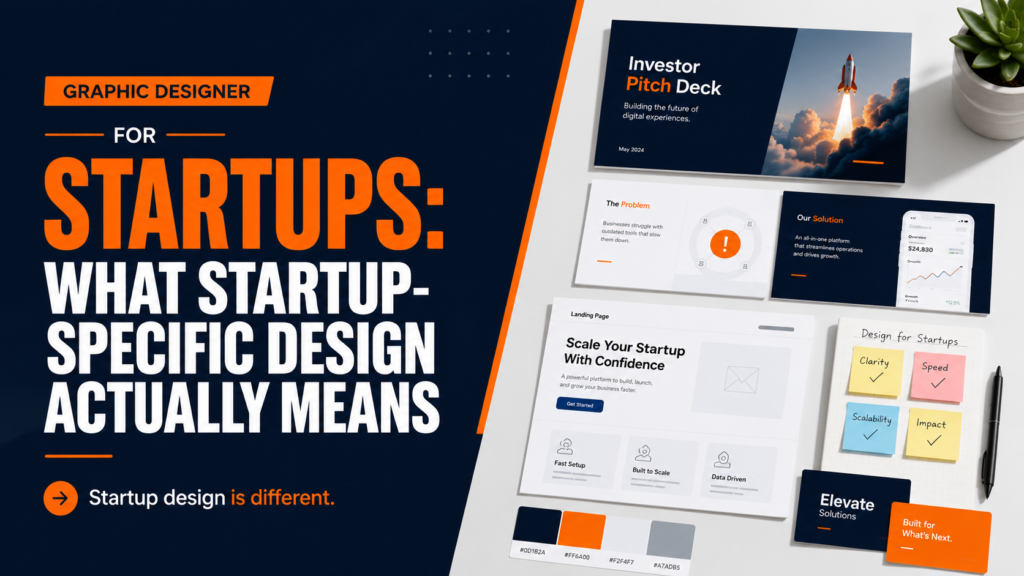
Most Startup Design Fails for a Predictable Reason
It’s not bad designers. It’s the wrong brief. Early-stage companies hire graphic designers to produce deliverables — a logo, a website, a deck — without the strategic context that would make those deliverables work. The designer produces something that looks professionally executed but doesn’t differentiate from competitors, doesn’t resonate with the target buyer, and doesn’t scale when the company adds products, markets, or team members.
A graphic designer who works specifically with startups understands this pattern and designs for it. They start with positioning and context before picking up a pencil. They design for the constraints of early-stage execution: limited team, limited budget, need for materials that a non-designer can update and maintain. And they produce work that’s built to scale — a system rather than a series of one-off deliverables that don’t hang together.
This guide explains what a startup graphic designer does differently, what to look for when choosing one, and how to brief them so you get the output your business actually needs.
“An early-stage startup doesn’t need perfect design. It needs design that’s clear enough to win trust, flexible enough to update, and distinctive enough to be remembered. That’s a specific skill.”
— Jessica Hische, lettering artist and brand designer
What a Startup Graphic Designer Handles
What Makes Startup Design Different from Regular Design Work
Speed and Prioritization
Enterprise design projects can run for months with multiple stakeholder review cycles. Startup design needs to move in weeks, with one or two decision-makers, and produce work that’s useful immediately. A graphic designer who works with enterprises but not startups often brings a cadence and process that’s mismatched to startup timelines — either too slow for the moment (a six-week brand project when you need materials for a conference in three weeks) or too extensive for the current stage (a 60-page brand guidelines document when a 10-page one would serve the team better).
Constraints as a Creative Brief
Early-stage startups operate with real constraints: small budgets, teams that will use design templates without any design knowledge, products that will change and need materials that age gracefully. A startup graphic designer designs within these constraints by default — producing templates that are genuinely editable by non-designers, building brand systems that are flexible enough to accommodate product pivots, and scoping deliverables to match budget rather than padding scope.
Designing for Investor Credibility
Startups interact with investors in ways that most established businesses don’t. The visual quality of the pitch deck, the website, the one-pager, and the investor update email all communicate something about how seriously the founders take presentation and operational discipline. A graphic designer with startup experience understands this particular audience — investors who see hundreds of decks — and designs for the specific credibility signals that influence investment decisions.
Building for Team Scalability
A startup’s design output at pre-seed is produced by the founder or one designer. At seed, a marketing hire needs to produce materials independently. At Series A, a full marketing team does it. The brand system and templates built at the beginning need to hold up across all of these stages. Startup-specific graphic design builds for this scalability by creating clear guidelines, editable master files, and a system with enough structure to stay consistent without requiring a designer on every project.
Startup graphic design
Design built for how startups actually operate.
Brand identity, pitch decks, website design, and marketing materials — scoped for startup timelines, built to scale with your team.
How to Evaluate a Graphic Designer for Your Startup
Has the Portfolio Been Through a Startup Context?
Beautiful work from established brand clients proves a designer can produce high-quality output. It doesn’t prove they can handle the ambiguity, speed, and constraint of a startup context. Look specifically for portfolio cases that include early-stage companies — ideally with some context about what the brand needed to achieve, not just what it looked like. Designer who include “brand before” states and explain the strategic problem they solved are typically more valuable for startups than designers who present polished visual portfolios without context.
What Does Their Brief Process Look Like?
Ask the designer: “What do you need to know before you start any design work?” A designer oriented toward startups asks about business model, target buyer, competitive positioning, and funding stage — because all of these affect design decisions. A designer oriented toward aesthetics asks about design preferences and color palettes. The first kind of brief produces work that’s strategically appropriate; the second produces work that looks good to the client but may not resonate with the buyer.
Can They Show You Process, Not Just Output?
Process shows whether the designer’s thinking is systematic or intuitive. Systematic design process — discovery, concept, refinement, production — produces more consistent results and more predictable timelines. It also produces work that’s easier to explain and defend when multiple stakeholders have opinions. A designer who can walk you through why every decision was made is easier to work with than one who presents polished finals and resists explaining the reasoning.
Do They Offer Startup-Appropriate Scope Options?
A designer who only works on full brand identity systems may not be the right fit for a pre-seed company that needs a logo and website in three weeks. A designer who can scope appropriately — delivering what the business actually needs now while building foundations for what it will need later — is the more useful partner at early stage. Ask specifically: “What would you recommend we prioritize given our current stage?”
The Startup Design Investment by Stage
Founder Personal Brand and Company Brand: The Connection
For founder-led startups, the company brand and the founder’s personal brand need to work together as a connected system. The founder’s LinkedIn profile, speaking deck, headshot, and written voice either amplify the company’s positioning or create fragmentation from it. Early-stage investors frequently check the founder’s personal presence before evaluating the company’s brand — and the two should reinforce each other.
Working with a graphic designer who can manage both dimensions — company brand and founder personal brand — as a connected system produces a significantly stronger effect than managing them separately. The same strategy that helps the most productive founders scale their time output also applies to brand: build systems that multiply effort rather than doing every piece of communication from scratch.
Founders building brands that need to convert not just website visitors but also investors, enterprise buyers, and talent candidates should think about their personal brand as part of the company’s marketing infrastructure. The investment in a complete brand identity — company and founder — consistently produces higher returns than either investment made separately.
The Startup Design Priority Stack: What to Build in What Order
One of the most common startup design mistakes is investing in the wrong deliverable at the wrong time. A founder who spends $15,000 on a full brand identity system at pre-revenue has over-invested in brand and under-invested in the specific design that would move the needle at that stage. The priority stack below reflects the sequence that consistently produces the highest ROI for early-stage companies.
Stage 0: Idea and Pre-Revenue
At idea stage, the only design that matters is the design that helps you validate: a landing page that communicates the value proposition clearly enough to generate signups or email addresses, and a minimal logo or wordmark that won’t actively embarrass you. This is not the stage for a brand identity system. It’s the stage for directional, fast, good-enough design that can be validated quickly and updated without grief when the product direction shifts — and it will shift.
Total design investment at this stage: $1,000 – $3,000. An overspend here, before product-market fit is even approached, is a startup mistake that’s surprisingly common and surprisingly expensive.
Stage 1: First Customers and Early Traction
Once you have early customers and a stable product direction, the priority shifts to brand identity. The landing page that got your first 50 signups will not close your first 50 enterprise deals. The logo you sketched in Canva will not hold up on an investor pitch deck. This is the stage to invest in a complete brand identity system: logo, color palette, typography, voice guidelines, and core templates. Budget: $5,000 – $15,000 depending on complexity.
Stage 2: Fundraising or Enterprise Sales
When you’re entering fundraising or actively pursuing enterprise contracts, the pitch deck and sales materials become the highest-priority design investments. A professionally designed pitch deck pays for itself many times over if it contributes to closing a round or a large contract. The ROI math is clear: if a $4,000 pitch deck helps close a $500,000 seed round or a $100,000 enterprise contract, the design cost is trivially small relative to the outcome. Budget for this stage: $3,000 – $10,000 for pitch and sales materials, built on top of the brand identity from Stage 1.
Stage 3: Scale and Team Growth
At this stage, the design priority is infrastructure — making it possible for a growing team to produce on-brand work without a designer’s involvement in every piece of content. This means extended brand guidelines, additional templates (proposal templates, report templates, campaign assets), and potentially a design system if the product has a significant UI component. The investment at this stage is less about creating new design and more about systematizing the design that already exists so it scales with the team.
The Design Investments That Always Pay Back
Regardless of stage, some design investments consistently generate returns that justify their cost:
- A pitch deck that’s better than the competition’s — investors form visual impressions of operational quality before they analyze the business metrics.
- A website that converts at above-category rates — every percentage point of conversion improvement compounds across the lifetime of your traffic.
- Brand guidelines that new hires can actually follow — the cost of off-brand content produced by non-designers accumulates silently across every meeting, email, and document that goes out with the wrong logo.
- A logo that works at every size and in every context — a logo that breaks at favicon size or looks wrong on a dark background will be used incorrectly for years, creating visual inconsistency that erodes brand recognition.
Work With a Graphic Designer Who Gets Startups
Lalit Bahel works specifically with startups, founders, and early-growth B2B companies on brand identity, pitch decks, website design, and marketing collateral. Every project starts with a brief that covers strategy and context — because design that doesn’t solve a specific business problem isn’t useful, regardless of how good it looks. Engagements are scoped for startup timelines and startup budgets, with deliverables built to scale as the company grows.
Startup graphic design
Design that works at pre-seed and holds up at Series B.
Brand identity, pitch decks, website design, and marketing templates — scoped for startup speed and built for long-term scale.