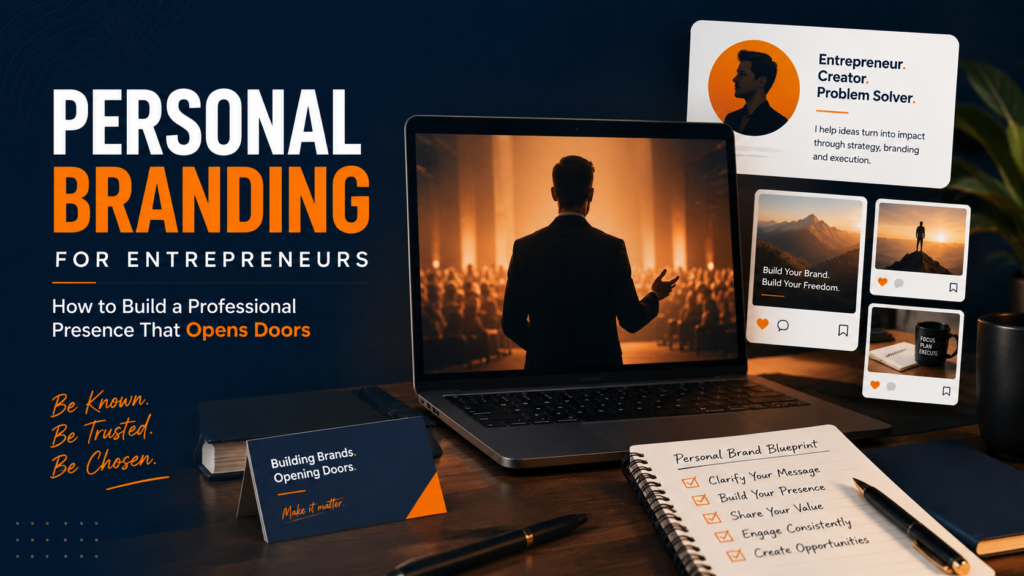
Personal Branding for Entrepreneurs: How to Build a Professional Presence That Opens Doors
Personal branding for entrepreneurs isn’t about self-promotion—it’s about intentional presence. It’s the difference between having your name show up when someone Googles you and having your name mean something when it does. Between being a founder and being a thought leader in your category. Between spending most of your business development time explaining who you are and having opportunities come to you because people already know.
In a world where every investor, potential partner, enterprise customer, and potential hire will research you before they meet with you, your personal brand is your first impression at scale. This guide explains what personal branding actually involves, why it matters specifically for entrepreneurs, and how to build one that compounds over time rather than requiring constant effort to maintain.
“Your personal brand is the story people tell about you when you’re not in the room. Personal branding is taking control of that story.” — Jeff Bezos
Why Personal Branding Matters More for Entrepreneurs Than for Anyone Else
You Are the Company’s First Brand Signal
For early-stage companies, the founder’s credibility and reputation is the company’s primary trust asset. Investors fund people, not decks. Enterprise buyers often make vendor decisions based as much on trust in the founding team as on product evaluation. A strong founder personal brand reduces the friction in every business relationship before those relationships begin.
Investors Research You Before They Research Your Company
Research from First Round Capital and other venture firms consistently shows that team is the leading investment criterion at early stages. Before a VC opens your deck, they’ve Googled you. They’ve checked your LinkedIn. They may have read your writing or seen a talk you gave. What exists at that moment is your personal brand—built intentionally or accidentally.
Thought Leadership Creates Business Development Leverage
A founder with genuine thought leadership in their category—someone whose writing gets shared, whose talks fill rooms, whose perspective is sought by journalists—generates inbound business development opportunities that couldn’t be created through outbound effort alone. The leverage ratio is significant: one well-distributed piece of thinking can reach thousands of potential customers or partners who are pre-educated about why your company exists.
It Compounds Over Time
Unlike advertising (which stops working when you stop paying) or cold outreach (which requires constant effort), personal brand compounds. Every talk, every article, every meaningful social media contribution adds to a body of work that creates ongoing credibility and discoverability. The best time to start building a personal brand was five years ago; the second best time is today.
The Five Dimensions of Entrepreneur Personal Branding
1. Professional Positioning
What are you known for? The clearest and most powerful personal brands are built on a specific expertise or perspective, not on a generic identity. “Entrepreneur” is not a personal brand. “The person who helps Series A SaaS companies build their first sales team” is a personal brand. Specificity makes you memorable and referrable.
Your professional positioning should answer:
- What specific expertise do you have that is genuinely rare or distinct?
- Who specifically benefits from that expertise?
- What is your perspective on your category that is different from the conventional wisdom?
- What do you want to be the go-to person for?
2. Visual Identity
Personal brand visual identity is often reduced to a headshot and a LinkedIn banner, but it encompasses everything visual about your professional online presence. Your headshot quality, your website design, your speaking slide design, your social media graphics—all of these contribute to the visual impression you make at first contact.
Minimum visual identity requirements for a serious personal brand:
- Professional headshot (not a cropped photo from a social event)
- Consistent photography style across all platforms
- LinkedIn profile banner that communicates what you do
- Personal website that presents your work, thinking, and contact information
- Consistent use of color and typography in content you produce
The visual identity of your personal brand should be designed to reinforce your positioning, not just to look professional. A founder positioning themselves as a creative, design-forward thinker needs visual identity that demonstrates those values. For founder-specific visual identity design, see the personal branding design service for founders and CEOs.
3. Content and Thought Leadership
Content is how personal brand becomes thought leadership. Writing, speaking, podcasting, and social media participation are all ways of externalizing your expertise in formats that can be discovered, shared, and linked to. The specific format matters less than the quality and consistency of the thinking.
Content formats that build entrepreneur personal brand:
- Long-form writing: Blog posts, LinkedIn articles, newsletter issues. Demonstrates depth of thinking; creates searchable, linkable content
- Short-form social: Twitter/X threads, LinkedIn posts. Enables rapid distribution of specific insights; builds audience faster than long-form alone
- Speaking: Conference talks, panels, podcast appearances. Creates credibility through live performance; reaches audiences who don’t find written content
- Podcast hosting: Positions you as a connector and knowledge curator; creates regular touchpoints with your audience and with guests who become relationship assets
- Book authorship: The highest-credibility signal in thought leadership; requires the most investment but creates the most durable brand asset
4. Network and Community
Your network is both evidence of and contributor to your personal brand. Who you know, who knows you, and what community you participate in shapes how others evaluate your credibility and relevance. Strategic network development—not transactional networking, but genuine relationship building with people doing interesting things in your space—creates the social capital that makes personal brand work at scale.
5. Online Presence and Discoverability
The practical question of “what does someone find when they Google your name” is the personal brand audit most entrepreneurs have never done deliberately. Before you invest in building personal brand content, understand the current baseline:
- What appears in the first 5 results for your full name?
- Is your LinkedIn profile complete, accurate, and optimized for the right keywords?
- Do you have a professional website? Does it appear in results?
- What does your social media presence look like to a stranger?
- What content have you published that is searchable?
Building Your Personal Brand: A Practical Sequence
Step 1: Define Your Positioning Statement
Before any content creation or visual investment, articulate who you are, what you’re known for, and who benefits from your expertise in one or two sentences. This statement should be specific enough to be meaningfully different from any other founder in your space, and clear enough that someone who reads it immediately understands why they should pay attention to what you say.
Step 2: Audit and Clean Up Your Current Online Presence
Update your LinkedIn profile to reflect your current positioning. Remove or update outdated bios on social platforms. Ensure that the first page of Google results for your name presents a coherent, professional picture. Fix anything that contradicts the positioning you want to own.
Step 3: Build the Foundation Assets
Professional headshot. LinkedIn banner. Personal website with clear bio, contact information, and a starting point for your content. These assets should all exist before you begin active content distribution—they’re the destination that your content directs people to.
Step 4: Choose One Content Channel and Commit to It
The most common personal branding mistake is trying to be everywhere simultaneously and producing mediocre content on every platform. Choose the one channel where your target audience is most concentrated and where you can produce content in a format that plays to your strengths. Commit to a realistic publishing cadence and maintain it for at least six months before adding a second channel.
Step 5: Engage With Your Community
Content distribution without community engagement is broadcasting. The personal brands that compound fastest are built on genuine relationship: responding to comments, engaging with others’ content, participating in conversations, and helping others without immediate transactional intent.
For founders who want to integrate their personal brand with their company’s brand, read about why founders need personal branding. For the visual identity component of your personal brand—headshot direction, website design, and LinkedIn presence—see the personal branding design service.
Personal Brand and Company Brand: Managing the Relationship
For founder-led companies, the relationship between personal brand and company brand requires deliberate management. Tightly linking the two creates synergy when things go well but creates risk when they don’t: a founder who leaves or suffers a reputation event takes the brand with them. Maintaining complete separation misses the opportunity to leverage the founder’s authentic credibility to build the company’s brand.
The best model: build the founder’s personal brand as a genuine expert identity that is related to but distinct from the company brand. The personal brand should be able to stand alone; the company benefits from association with it, but doesn’t depend on it. This model creates maximum leverage in the short term while managing long-term brand risk.
For the company brand identity that should run in parallel to founder personal branding, see the branding and identity design service. To discuss how to build both in a coordinated way, start a conversation about your specific situation.
Your Expertise Deserves a Brand That Reflects It
Personal branding for entrepreneurs isn’t vanity—it’s leverage. The founder who is known for something specific, who has a professional presence that matches their expertise, and who shows up consistently for their community wins more deals, raises better rounds, and attracts better talent than the founder who doesn’t. Let’s build yours.