Presentation Design Services: What They Include, Why They Matter, and How to Choose the Right Designer
A great presentation is one of the most undervalued business tools in a founder’s or executive’s toolkit. It’s the document that closes funding rounds, wins enterprise contracts, and lands speaking opportunities. It’s the first impression investors have of your team’s thinking. It’s the evidence that your company presents ideas with clarity and professionalism.
And yet most presentations are built under deadline, in PowerPoint or Keynote, by whoever has time, using templates that don’t match the brand, with slides that put too much text on every page and visuals that look like stock photos from 2015.
Professional presentation design services exist because the gap between a presentation that works and one that doesn’t is significant—and closing that gap requires specific skills that most business professionals don’t have: narrative structure, information hierarchy, visual storytelling, and technical execution across slide software platforms.
This guide explains what professional presentation design services include, when they’re worth the investment, and how to find and evaluate the right designer for your specific needs.
“A presentation is not a document with slides. It’s a narrative experience. The design serves the narrative—every visual choice should help the audience receive the story, not distract from it.” — Nancy Duarte
What Presentation Design Services Actually Include
The scope of presentation design services varies significantly by designer and project type. Understanding what’s included helps you brief accurately and evaluate proposals fairly.
Core Deliverables
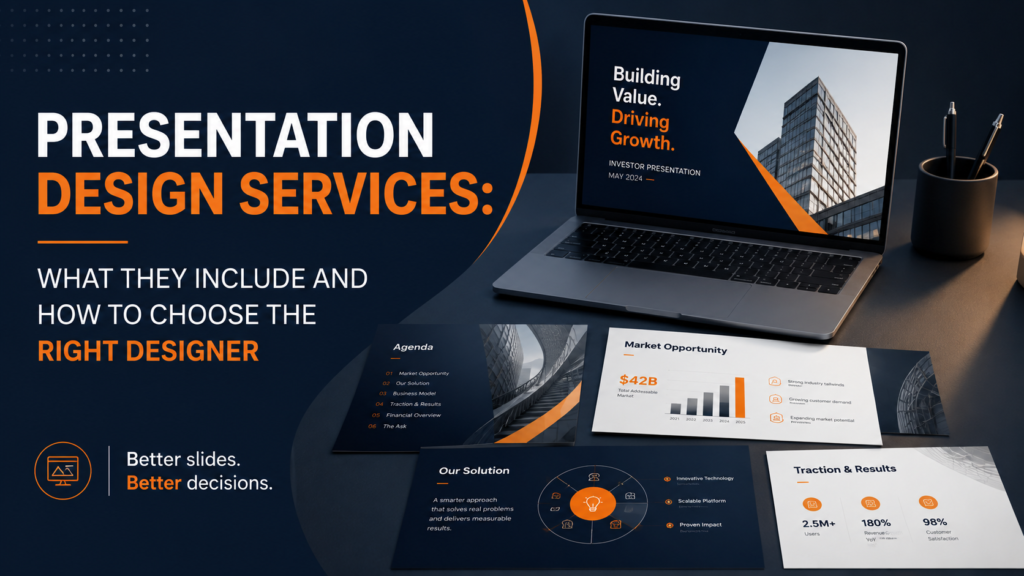
- Slide template design — A set of master slide layouts that establish the visual system: title slides, section headers, content layouts, data visualization templates, image-full slides, quote slides, and an ending slide. These masters become the reusable foundation for all future presentations.
- Individual slide design — Applying the template to your specific content, with layouts optimized for each slide’s information type and audience need.
- Data visualization — Charts, graphs, and data tables redesigned from default Excel/Google Sheets output into visually clear, brand-consistent graphics that communicate the data point, not just the data.
- Custom graphics and icons — Conceptual diagrams, process flows, comparison frameworks, and custom iconography that communicate ideas that text alone cannot convey effectively.
- Image sourcing and editing — Selection, licensing, and editing of photography to match brand direction and support slide content.
- Final file delivery — The completed presentation in your chosen software format (PowerPoint, Keynote, Google Slides, or PDF), plus any supporting assets.
Often Included in Premium Services
- Narrative structure consultation — Review and improvement of slide order, story arc, and message hierarchy before design begins
- Speaker notes — Written speaking guidance for each slide
- Animated version — Slide builds and transitions for live delivery contexts
- Multiple format exports — Screen presentation (16:9), print/PDF, wide-format (16:10 for some projectors)
- Slide library — A modular collection of slides you can recombine for different audiences
The Four Types of Presentations Designers Specialize In
Each type requires a different design approach. A pitch deck optimized for a 20-minute VC meeting will not work as a conference keynote, and a keynote built for visual drama will not work as a board report. Brief your designer on specifically what type of presentation you need and how it will be delivered.
Investor Pitch Deck Design: The Highest-Stakes Presentation
The investor pitch deck deserves special attention because it’s the presentation with the highest ROI on design investment. A seed round that closes on $3M can be materially influenced by how the deck communicates the team’s thinking and market understanding. Design quality signals execution quality to investors who have seen thousands of pitches.
What Makes a Pitch Deck Design Work
Hierarchy and flow: Every slide should be readable in under 10 seconds. The headline states the point; the visual proves it; the supporting text provides context. Investors read decks quickly—sometimes while distracted. Design that requires focused reading loses them.
Data visualization quality: Market size slides, financial projections, and traction graphs are where most pitch decks fail visually. Excel-default charts are a red flag to investors who have seen thousands of carefully crafted decks. Custom-designed data visualizations that make the key insight immediately visible communicate both the insight and the team’s attention to detail.
Visual authority: The overall visual presentation—typography quality, color consistency, image direction, spacing precision—creates a halo effect on how investors perceive the team’s competence. This is irrational (design ability and business ability are separate skills) but consistent. Professional presentation design creates professional impression.
For the full guide to pitch deck design and what separates successful decks from unsuccessful ones, see the pitch deck design services guide and how much a pitch deck design costs. The pitch deck design service is built specifically for founders who need investor-ready presentation design.
The Presentation Design Process: What to Expect
Phase 1: Content Review and Brief
Before any design begins, a professional presentation designer needs to understand the content, context, and delivery scenario. Key brief elements:
- What’s the audience, and what do you need them to do after seeing this?
- How will it be delivered (live, sent as PDF, video?)
- What’s your brand guide or existing visual identity?
- What’s the current draft (if any) and what’s wrong with it?
- What’s the core message you need the audience to leave with?
- What’s the timeline and revision process?
Phase 2: Template Design (If Not Existing)
If you don’t have a presentation template, the designer builds one. This typically takes 3–5 business days and includes 8–12 master slide layouts, full color system application, typography hierarchy, and basic graphic elements. The template is the foundation; individual slide design is faster once the template is solid.
Phase 3: First Draft
The designer produces all slides in the first draft. For pitch decks, this is usually 2–3 working days after the brief. For larger decks (30+ slides), allow 5–7 days. The first draft is for structure and direction feedback, not polish—your job at this stage is to evaluate whether the narrative flow works and whether the visual direction is correct, not to proof every word.
Phase 4: Revision Rounds
Most professional presentation design packages include 2–3 revision rounds. Effective revision feedback is specific and addresses one category at a time: structure first, then visual direction, then individual slide content and layout. Mixing “I want to add a slide about X” with “the blue feels too light” and “the font on slide 7 looks different” in a single round slows the process significantly.
Phase 5: Final Delivery
Final files are delivered in the agreed format, plus a PDF version for sharing, and typically a short usage guide explaining how to create new slides in the template style. A good designer will also include native editable files even if you paid for only PDF delivery.
What Presentation Design Costs: A Realistic Breakdown
Rush fees (48-hour turnaround or faster) typically add 50–100% to the base price. If your pitch is in 3 days and you need a full deck design, expect to pay accordingly—or plan further ahead next time.
How to Evaluate a Presentation Designer’s Portfolio
Not all presentation designers have the same skills. When evaluating portfolios:
Look for Information Hierarchy, Not Just Visual Polish
A slide can look beautiful while communicating nothing. The best presentation design makes the key message immediately legible: what’s the point of this slide, and how does the design make that point clear? If you have to look at a portfolio slide for more than 5 seconds to understand what it’s saying, the design is failing at its job.
Check Data Visualization Quality
Data visualization is a specific skill separate from slide design. Look for examples of charts and graphs in the portfolio. Are the axes clearly labeled? Is the key data point visually emphasized? Does the chart tell a story, or just display data? Poor data visualization is a significant weakness in presentation design because financial decks, board reports, and sales decks all require heavy use of quantitative information.
Assess Brand Consistency
Does the portfolio show that the designer can work within a brand system? Every slide in a presentation should feel like it belongs to the same family. If the portfolio shows inconsistency in color use, typography, or visual treatment within a single project, that’s a red flag.
Ask About Process
A good presentation designer will ask about your audience, delivery context, and narrative goals before talking about visual direction. A designer who wants to jump immediately to aesthetics without understanding the strategic context will produce beautiful slides that don’t serve the business objective.
For founders and executives who need both brand-consistent visual design and strategic narrative support for their presentations, the pitch deck and business brochure design service combines both. For questions about your specific project, reach out to discuss the scope and timeline.
Your Next Presentation Should Be Your Best One
Whether you’re pitching investors, presenting to a board, speaking at a conference, or closing an enterprise deal, professional presentation design transforms how your audience receives your message. Let’s build a presentation that works as hard as the content inside it.